VPN for Perplexity AI: Access, Privacy & Travel Tips

Last updated: May 4, 2026
Perplexity AI + VPN Guide

VPN for Perplexity AI: Privacy, Travel, and AI Search Access

Perplexity is different from a normal chatbot. It works more like an AI-powered answer engine, searching the web and giving answers with source links and citations. That makes it useful for research, SEO, marketing, travel planning, shopping research, and fact-checking.

A VPN may help Perplexity users in some cases, especially on public Wi-Fi, while traveling, when testing regional search results, or when a school, office, hotel, airport, café, or library network blocks AI tools. But a VPN can also cause issues because Perplexity uses Cloudflare checks, and Perplexity’s own help center says VPNs may increase Cloudflare screens or interfere with performance.

Quick answer
A VPN can help protect your connection while using Perplexity on public Wi-Fi and can help test AI search results from different locations.
Important limit
Perplexity says VPNs may increase Cloudflare checks or interfere with performance, so a VPN can sometimes be the problem.
Best use case
Research privacy, travel access, school/work network troubleshooting, and regional AI search testing.

If you use several AI tools, start with our main guide to the best VPN for AI tools. If your main concern is privacy, also read our guide to using a VPN for AI privacy.

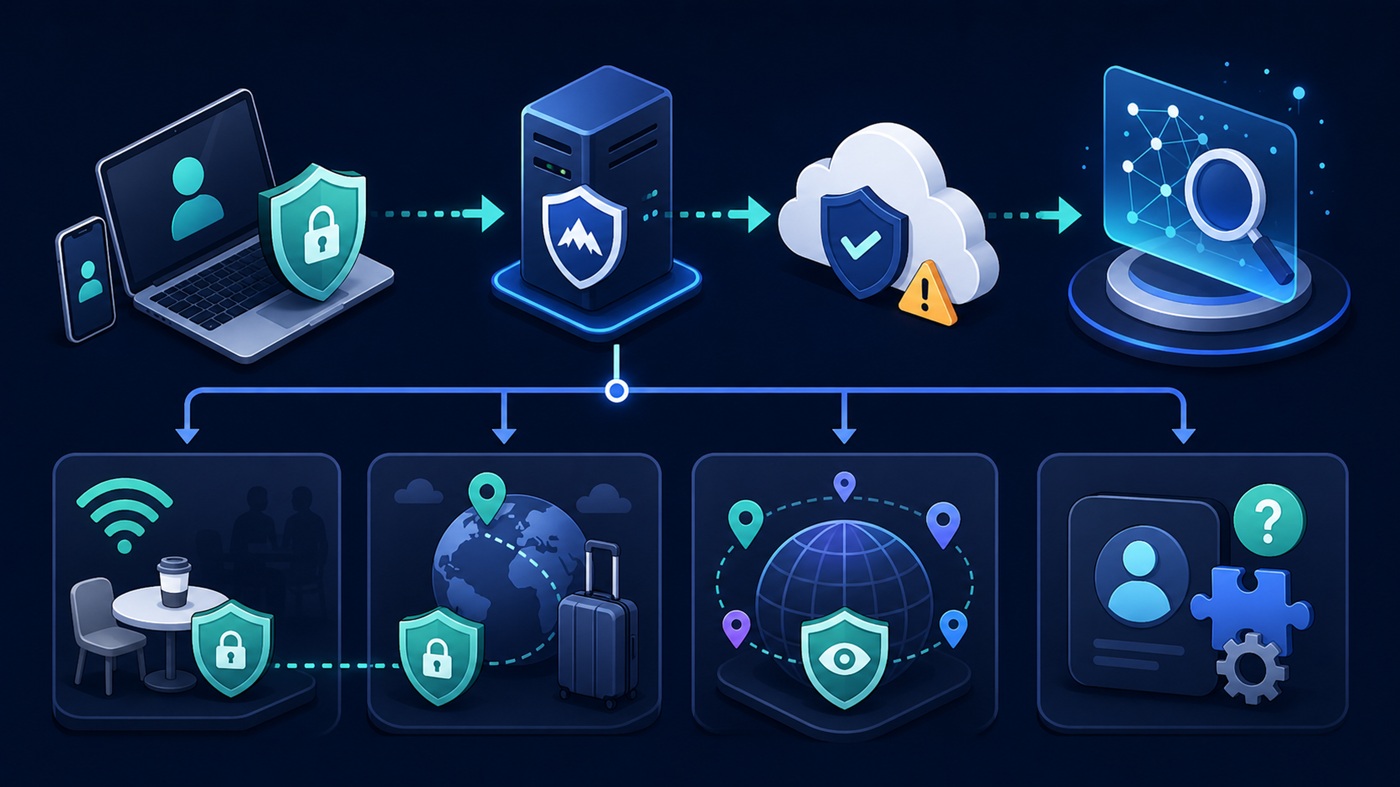
Perplexity AI search privacy with VPN protection
A VPN can help protect your connection while using Perplexity on public Wi-Fi or while traveling.

Quick Answer: Should You Use a VPN With Perplexity AI?

Yes, a VPN can be useful with Perplexity if your goal is privacy, public Wi-Fi protection, travel access, or AI search testing from different locations. A VPN changes the public IP address that websites see and helps protect the connection between your device and the VPN server.

But Perplexity is also one of the AI tools where a VPN can sometimes create friction. Perplexity’s help center says using VPNs increases the likelihood of Cloudflare checks. Its enterprise troubleshooting page also says VPNs may interfere with Perplexity’s performance due to Cloudflare settings.

So the honest answer is: use a VPN when it helps your privacy, travel, or network situation, but turn it off or switch servers if Perplexity starts showing Cloudflare screens, sign-in errors, or performance issues.

A VPN is useful for Perplexity privacy and region testing, but it is not always the fix. If Perplexity shows Cloudflare checks, the VPN server itself may be causing the problem.

What Is Perplexity AI?

Perplexity is an AI-powered search and answer engine. Instead of only giving a list of links, it searches the web, summarizes information, and includes citations or links to original sources so users can verify the answer.

This makes Perplexity useful for research-heavy tasks, such as comparing products, checking current events, finding sources, summarizing topics, researching companies, studying competitors, and exploring questions where source quality matters.

Because Perplexity works with live web information and citations, VPN location can matter in a different way than it does for normal AI chat. Search results, source discovery, local context, and content availability may vary depending on the visible region, query, language, and network.

When a VPN Can Help With Perplexity AI

A VPN is most useful with Perplexity when the issue is your network, visible location, or privacy situation. For example, if you are using Perplexity on hotel Wi-Fi, airport Wi-Fi, public library Wi-Fi, a café network, or a coworking space connection, a VPN can add a privacy layer to the session.

A VPN can also help researchers, SEOs, marketers, and travelers test how AI search answers change when the visible location changes. This is useful when researching local businesses, travel topics, regional services, country-specific news, or location-sensitive source discovery.

A VPN may help with:

  • Public Wi-Fi privacy while using Perplexity
  • Hotel, airport, café, school, library, or coworking network blocks
  • Travel-related access problems
  • Testing whether AI search results change by region
  • Researching local results from another country
  • Protecting research sessions on shared networks

A VPN may cause problems with:

  • Cloudflare loading screens
  • Extra security checks
  • Sign-in friction
  • Slower performance
  • Blocked or abused VPN IP addresses
  • Enterprise network troubleshooting

Perplexity, Cloudflare, and VPN Problems

This is the part many VPN articles ignore. Perplexity’s own help center has a Cloudflare and VPN article. It explains that Cloudflare performs user checks to limit spam, abuse, and malicious activity. It also says using VPNs increases the likelihood of encountering Cloudflare checks.

Perplexity’s enterprise troubleshooting page gives similar advice. It says VPNs may interfere with Perplexity’s performance because of Cloudflare settings and suggests disabling the VPN and trying to sign in again if needed.

That does not mean a VPN is bad for Perplexity. It means the VPN server quality matters. A clean, stable, less-crowded server may work better than an abused or overloaded VPN IP address.

Important: If Perplexity works without a VPN but fails with the VPN on, switch VPN servers first. If the problem continues, temporarily disconnect the VPN and test again.

Perplexity Privacy: What a VPN Protects

A VPN protects the network connection. It can help hide your real IP address from websites and reduce exposure on public Wi-Fi. This matters when you are using Perplexity for research, work, travel planning, shopping comparisons, market research, or SEO analysis from shared networks.

A VPN is especially useful when you are using Perplexity from:

  • Hotels
  • Airports
  • Cafés
  • Libraries
  • Universities
  • Coworking spaces
  • Conference Wi-Fi
  • Public mobile hotspots

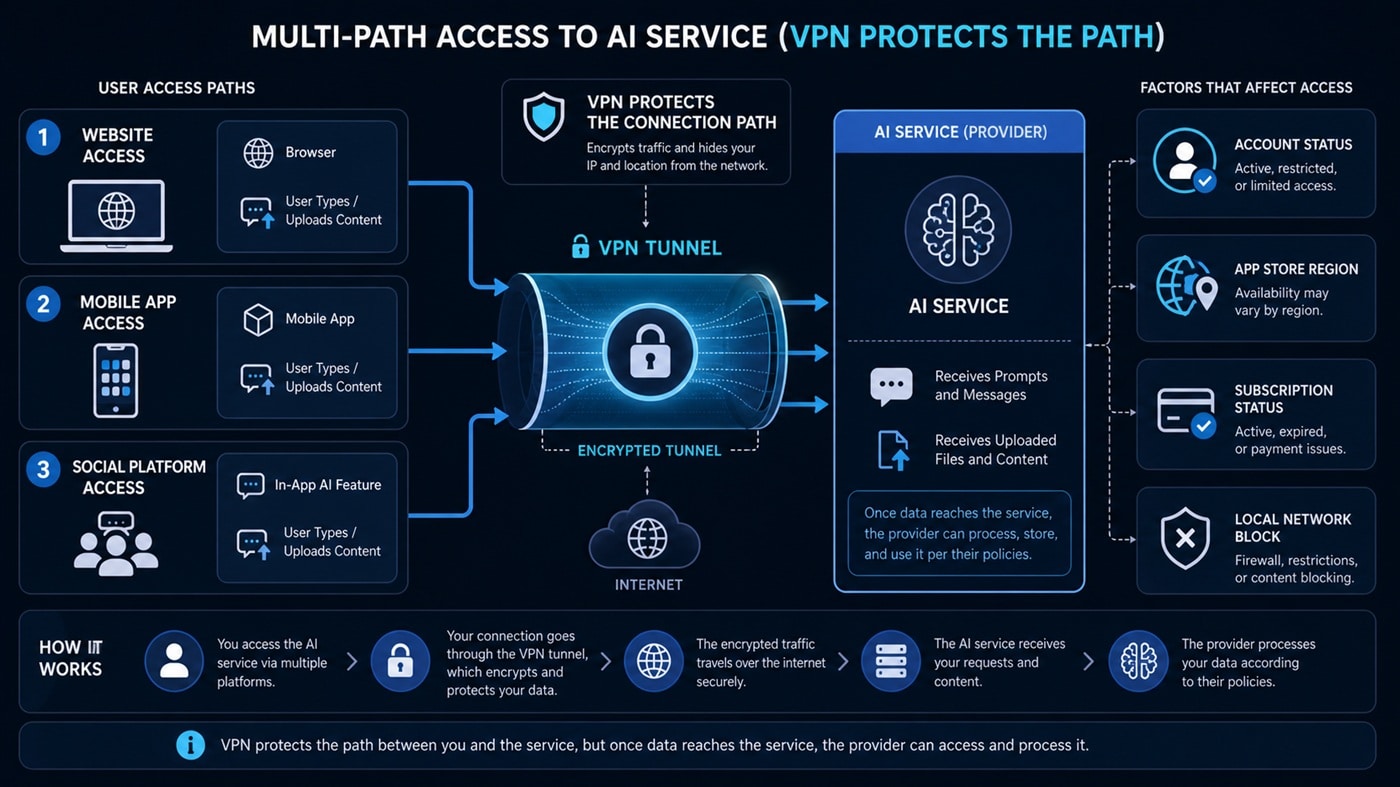
However, a VPN does not make your Perplexity searches invisible to Perplexity itself. The service still receives the queries, files, account activity, and interactions you submit.

What Perplexity Can Still See

Perplexity’s help center says it collects data from your device and interactions with its site. It also says personal information may be stored when you create an account and that the company does not sell your data.

Perplexity’s data collection help page says data collection supports product functionality, account security, service improvement, and AI model training unless users opt out through account settings. Perplexity also provides account deletion information and says personal information is removed from its servers within 30 days after account deletion.

VPN privacy

A VPN protects the connection, masks your real IP address from websites, and reduces local network snooping.

Perplexity account privacy

Perplexity can still process your searches, uploaded files, account activity, and interactions according to its privacy settings and policies.

Perplexity and File Upload Privacy

Perplexity supports file uploads. Its help center says users can upload text files, code, PDFs, images, audio, and video files. It also says audio and video files can be transcribed into text and made searchable in Perplexity.

This makes privacy more important. If you upload sensitive files, a VPN protects the connection, but Perplexity still receives the file contents. Do not upload confidential client files, private business documents, passwords, API keys, legal records, medical records, or personal IDs unless your account settings, plan, and privacy expectations are appropriate.

AI search region testing with Perplexity and VPN server locations
Researchers, marketers, and SEO users can test how AI search answers and source discovery change by region.

Using a VPN for Perplexity Region Testing

Perplexity is useful for source discovery and AI search. If you are doing SEO, affiliate research, local business research, travel research, or competitive analysis, you may want to compare answers from different regions.

For example, a user researching “best VPN for AI tools,” “best cafés in Dubai,” “AI tools in Canada,” or “local privacy laws” may see different sources or context depending on location, language, and search intent.

A VPN can help you test from another visible location. This is not guaranteed to change every Perplexity answer, but it can be useful when you want to understand how AI search behaves across countries.

USA server

Useful for US-focused AI research, technology topics, software searches, and US-first AI feature testing.

UK or Europe server

Useful for European privacy topics, UK/EU search intent, and English-language research with lower latency for some users.

Canada server

Useful for North American research when you want a non-US comparison point.

Japan or Singapore server

Useful for Asia-Pacific research, regional AI tool testing, and faster routing for users near those regions.

For a broader breakdown, read our guide to the best VPN locations for AI tools.

Perplexity on School, Work, and Public Networks

Some networks block AI tools or search tools even when the service itself is available. A school may block AI search because of academic integrity concerns. A workplace may block Perplexity to reduce data leakage. A hotel or airport network may block traffic categories or trigger Cloudflare checks.

A VPN may help if the problem is network-level filtering. But you should respect the rules of the network you are using. Do not use a VPN to violate school, workplace, government-device, or employer policies.

School networks

Perplexity may be blocked because it is an AI research or answer tool. Follow school rules before trying to route around filters.

Workplace networks

Employers may block AI tools to prevent sensitive data from leaving company systems.

Hotel and airport Wi-Fi

Public travel networks may trigger Cloudflare checks, slow performance, or block categories of web traffic.

Café and library Wi-Fi

A VPN adds privacy when using Perplexity on shared public networks.

How to Troubleshoot Perplexity With a VPN

If Perplexity is not working, test carefully before assuming the VPN is helping or hurting.

  1. Try Perplexity without the VPN. If it only fails with the VPN on, the VPN server may be triggering Cloudflare or performance issues.
  2. Switch VPN servers. Try another nearby server or another country with better reputation.
  3. Log in before heavy use. Perplexity says Cloudflare screens anonymous users more frequently.
  4. Use a fresh browser session. Try private browsing or a clean profile to rule out cached problems.
  5. Hard-refresh the page. Perplexity’s enterprise troubleshooting recommends a hard refresh for browser issues.
  6. Check firewall settings. A local firewall, workplace filter, or school network may be blocking access.
  7. Update browser and app. Outdated browsers or mobile apps can cause sign-in and performance issues.
  8. Disconnect the VPN if needed. If Cloudflare keeps looping, temporarily disconnect and try again.

Best VPN Locations for Perplexity AI

The best VPN location depends on whether you are using Perplexity for privacy or research testing.

If privacy is your main goal, use the nearest stable server for better speed. If you are testing AI search results from another country, choose the country you want to research. If you are using Perplexity while traveling, choose a server that gives stable access without triggering repeated Cloudflare checks.

Nearest stable server

Best for public Wi-Fi privacy, speed, and general Perplexity use.

United States

Useful for US-focused research, technology queries, AI tool research, and US-market source discovery.

United Kingdom or Europe

Useful for European research, privacy topics, policy topics, and English-language search testing.

Japan or Singapore

Useful for Asia-Pacific research and smoother routes for users located closer to those regions.

What to Look for in a VPN for Perplexity

Because Perplexity may show Cloudflare checks with VPNs, VPN quality matters. You want a VPN account that is stable, fast, and lets you switch servers when one location has issues.

Stable servers

Repeated disconnects can cause login, Cloudflare, and session problems while using AI search tools.

Multiple locations

If one VPN server triggers Cloudflare checks, switching to another city or country can help.

Fast speed

Perplexity searches the web and loads sources, so slow VPN routing can make research frustrating.

DNS leak protection

DNS leaks can create mixed location signals and make troubleshooting harder.

Desktop and mobile support

Perplexity users often switch between browser, phone, tablet, and app-based research.

Public Wi-Fi protection

A VPN is most useful when using Perplexity on shared networks while traveling or working remotely.

Perplexity vs ChatGPT, Claude, and Gemini

Perplexity is often used differently from ChatGPT, Claude, and Gemini. ChatGPT and Claude are often used for writing, coding, brainstorming, and long-form chat. Google AI Studio and Gemini API are often used by developers. Perplexity is especially useful for search, current sources, citations, and research workflows.

That changes how a VPN helps. With Perplexity, a VPN is not only about access. It can also be useful for comparing source discovery across locations, protecting public Wi-Fi research sessions, and troubleshooting network blocks.

For related guides, see VPN for ChatGPT while traveling, VPN for Claude AI, Google AI Studio region errors, and VPN for Grok and X AI.

Final Verdict: Should You Buy a VPN for Perplexity AI?

Yes, a VPN can be worth it if you use Perplexity for research, SEO, travel planning, product comparisons, local search testing, or work on public Wi-Fi.

A VPN is useful for privacy, public Wi-Fi protection, travel access, network troubleshooting, and region testing. But it should not be treated as a guaranteed way to avoid Perplexity restrictions, Cloudflare checks, account issues, or provider rules.

If the VPN causes Perplexity to show Cloudflare screens, switch servers or temporarily disconnect. The best setup is a VPN account that gives you multiple reliable server locations and stable performance for all your AI tools.

For the full buyer guide, start with our main page on the best VPN for AI tools.

Need a VPN for Perplexity and AI Search?

Use a VPN account for public Wi-Fi privacy, travel access, AI search region testing, source research, and safer browsing while using Perplexity and other AI tools.

Buy a VPN Account
Note: A VPN may help with privacy and network troubleshooting, but it cannot guarantee Perplexity access or prevent Cloudflare checks.

FAQ: VPN for Perplexity AI

Can I use a VPN with Perplexity AI?

Yes, you can use a VPN with Perplexity AI, but it may not always improve the experience. A VPN can help with public Wi-Fi privacy and region testing, but Perplexity says VPNs may increase Cloudflare checks or interfere with performance.

Why does Perplexity show a Cloudflare screen when I use a VPN?

Perplexity uses Cloudflare for security and abuse prevention. Perplexity’s help center says using VPNs increases the likelihood of encountering Cloudflare checks.

Does a VPN protect my Perplexity searches?

A VPN protects your network connection and can hide your real IP address from websites, but Perplexity still receives the searches, prompts, files, and account activity you submit.

Can a VPN change Perplexity search results?

Sometimes. A VPN can change your visible location, which may help test whether AI search answers, local context, or source discovery changes by region. It will not guarantee different results for every query.

What VPN location is best for Perplexity?

If privacy is your goal, use the nearest reliable server. If you are testing research results from another country, choose a VPN server in that country.

What should I do if Perplexity does not work with my VPN?

Try switching VPN servers, logging in, using a fresh browser session, hard-refreshing the page, updating your browser, or temporarily disconnecting the VPN to see whether Cloudflare or the VPN server is the issue.

Official Sources Checked

Related Articles

VPN for Grok and X AI: Access, Privacy, and Region Issues

Last updated: May 4, 2026
Grok + X AI + VPN

VPN for Grok and X AI: Access, Privacy, and Region Issues

Grok is xAI’s AI assistant and is closely connected to the X ecosystem. Some users access it from Grok.com, some use the Grok mobile app, and others use Grok through X. That makes access issues more confusing than a normal AI chat website.

A VPN may help in some cases, especially when the problem is public Wi-Fi, workplace filtering, school network blocks, travel routing, visible IP location, or X/Grok access changing by region. But a VPN cannot guarantee Grok access, fix every app-store issue, change your X account status, or override platform rules.

Quick answer
A VPN may help with Grok when the issue is public Wi-Fi, network filtering, travel routing, or visible IP location.
Not guaranteed
Grok access may also depend on your X account, Grok account, app store region, subscription, platform rules, and local restrictions.
Best use case
Using Grok safely on shared Wi-Fi, testing region errors, and troubleshooting X or Grok access while traveling.

If you use multiple AI platforms, start with our main guide to the best VPN for AI tools. If your main concern is privacy while using AI tools, read our guide to using a VPN for AI privacy.

Grok and X AI access with VPN privacy protection
A VPN may help test whether a Grok or X AI access issue is caused by network filtering, travel routing, or visible IP location.

Quick Answer: Can a VPN Help With Grok?

Yes, a VPN may help with Grok when the issue is network-based. If Grok does not load on hotel Wi-Fi, airport Wi-Fi, a school network, a workplace network, a mobile carrier route, or a public hotspot, a VPN can help you test whether the problem changes through another server.

A VPN is also useful for privacy. It helps protect the connection between your device and the VPN server and can hide your real IP address from websites.

But Grok access is not only about IP address. Depending on how you use it, access can involve Grok.com, the Grok iOS or Android app, X, your X account, subscription status, app store country, local laws, and platform rules.

A VPN can help with Grok network access and public Wi-Fi privacy, but it cannot guarantee Grok availability or override xAI, X, app store, account, or local rules.

What Is Grok?

Grok is an AI assistant created by xAI. xAI describes Grok as available on Grok.com, iOS, and Android. X’s help center describes Grok as an AI assistant available to X users and powered by xAI’s large language model.

That creates several possible access paths:

  • Grok through Grok.com
  • Grok through the iOS app
  • Grok through the Android app
  • Grok inside X
  • Grok-related features tied to X accounts or subscriptions

If one access path fails, another may behave differently. For example, a user may have a problem with the mobile app but not the web version, or with X access but not Grok.com.

Why Grok or X AI May Not Work

When Grok does not load, it is easy to assume the whole service is blocked. In reality, the issue may be much more specific.

Network filtering

Schools, workplaces, hotels, airports, libraries, and public Wi-Fi networks may block X, Grok, AI tools, social platforms, or media-heavy services.

App store region

The Grok app may appear differently depending on Apple App Store or Google Play country, device region, account history, and rollout timing.

X account or subscription status

Some Grok features may depend on how you access Grok, your X account, plan, or account eligibility.

Local restrictions

Some countries may restrict X, specific Grok features, or AI-generated media tools. These restrictions can change quickly.

Public Wi-Fi routing

Hotel, café, conference, and airport networks can route traffic strangely or block categories that include AI or social platforms.

Platform or service downtime

If Grok, X, or the app store is having a service issue, a VPN may not fix it.

When a VPN Can Help With Grok

A VPN is most useful when the issue is caused by the local network or visible IP location. A VPN routes your connection through another server, which can help you test whether the problem changes when your traffic appears from a different place.

For Grok users, that can be useful while traveling, using shared Wi-Fi, working from coworking spaces, or testing whether X or Grok behaves differently through another server location.

A VPN may help with:

  • Public Wi-Fi privacy while using Grok or X
  • Hotel, airport, café, library, or coworking Wi-Fi blocks
  • School or workplace network filtering
  • Travel-related access problems
  • Testing whether a Grok error is based on visible IP location
  • Network routing issues affecting X or Grok

A VPN will not always help with:

  • X account restrictions
  • Grok account or subscription issues
  • App Store or Google Play country restrictions
  • Payment or billing problems
  • Local laws or regulator actions
  • Platform rules or service downtime

Grok.com vs Grok App vs Grok on X

Before troubleshooting, figure out where the issue happens. Grok can be accessed in more than one way, and each access path can fail for different reasons.

Grok.com

If Grok.com does not load, the issue may be local network blocking, DNS, browser cache, IP routing, account login, or regional availability.

Grok mobile app

If the app is missing or not working, the issue may involve app store region, device settings, account country, rollout timing, or mobile network routing.

Grok on X

If Grok fails inside X, the problem may involve your X account, X app version, X access in your country, subscription, or platform-side limits.

Grok API or developer access

If you use xAI developer tools, the request location may be your server, cloud environment, backend app, or API client, not just your browser VPN.

Grok Privacy: What a VPN Does and Does Not Protect

xAI’s privacy policy covers the Grok mobile apps, Grok.com, and other xAI services. xAI’s consumer FAQ also points users who access Grok through X to the X help center.

A VPN protects your network connection and can mask your real IP address from websites. That can reduce how much real network-location information is exposed during a session.

But a VPN does not hide the prompts, images, uploaded files, account activity, or messages you submit to Grok. The AI service you use still receives the content you send to it, and its privacy policy and settings still matter.

VPN privacy

Helps protect your connection on public Wi-Fi, masks your real IP address, and reduces local network snooping.

xAI / X privacy

Depends on how you access Grok, the applicable privacy policy, your account settings, and the content you submit.

Grok and X AI privacy data flow showing VPN protection and provider data handling
A VPN protects the connection path, but Grok or X still receives the prompts, files, images, and account activity you submit.

Grok and Country Restrictions

Grok availability can change because it depends on xAI, X, app stores, local rules, and rollout decisions. Avoid assuming that one old country list is always accurate.

There have also been recent examples of country-level restrictions involving Grok. AP reported that Indonesia conditionally restored Grok access after an earlier ban tied to concerns about explicit AI-generated content, and Reuters reported that Malaysia lifted a temporary Grok block after X implemented safety measures. Those examples show why Grok access can change quickly by country and by feature.

The safest approach is to check the official Grok, X, and app store availability for your account and device before relying on a VPN.

Important: If Grok or X is restricted by law, regulator action, app store policy, or platform rules where you are, a VPN may still leave you outside the official rules. Use a VPN for privacy, travel, and legitimate troubleshooting.

Can a VPN Help If X Is Blocked?

Sometimes. If Grok access depends on X and X is blocked on your network, a VPN may help test whether the block is local. This can happen on school Wi-Fi, workplace Wi-Fi, airport Wi-Fi, public networks, or in places where social platforms are filtered.

However, the same limits apply. A VPN may help with a network block, but it does not change your X account status, app permissions, local laws, subscription, platform rules, or device restrictions.

If your workplace or school blocks X or Grok, follow its rules. Using a VPN to bypass internal policy can create problems.

How to Test Whether a VPN Helps With Grok

Use a simple troubleshooting process before assuming Grok is unavailable.

  1. Check where the problem happens. Test Grok.com, the Grok app, and Grok through X separately.
  2. Try another network. Test mobile data, home Wi-Fi, hotel Wi-Fi, office Wi-Fi, or another public network.
  3. Update your app. Make sure X and Grok apps are current.
  4. Clear cache and cookies. Old browser data can keep login or region states stuck.
  5. Use a private browser window. This helps separate cookies from the current VPN connection.
  6. Connect to a VPN server before opening Grok or X. Do not open the app first and switch location afterward.
  7. Try a nearby server for privacy. If access already works, a nearby reliable server usually gives better speed.
  8. Try a USA or UK server for access testing. Use this when you suspect a region or routing issue.

Best VPN Locations for Grok and X AI

The best VPN location depends on what problem you are trying to solve. If Grok already works and you mainly want privacy, choose the nearest stable server. If you are testing access differences, try a server in a major supported market such as the United States, United Kingdom, Canada, Europe, Japan, or Singapore.

Nearest stable server

Best for public Wi-Fi privacy, speed, low latency, and normal Grok or X use when access already works.

United States

Useful for testing US-region behavior, app access differences, and AI feature rollouts.

United Kingdom or Europe

Useful for users who want English-language access testing and may need lower latency than a faraway US connection.

Japan or Singapore

Useful for Asia-Pacific users who need a closer route for AI tools and X-based workflows.

For a broader breakdown, read our guide to the best VPN locations for AI tools.

What to Look for in a VPN for Grok

If you want a VPN for Grok, X, and other AI tools, choose one that is practical for daily use, not just one that claims to “unblock everything.”

Fast, stable servers

Grok, X, image tools, and AI chats feel better when pages load quickly and sessions stay stable.

DNS leak protection

DNS leaks can create mixed location signals and make region troubleshooting harder.

Mobile and desktop support

Grok users may switch between Grok.com, iOS, Android, X mobile, and desktop browser sessions.

Multiple server locations

If one network route is blocked or slow, another VPN location can help you test the issue.

Public Wi-Fi protection

A VPN is useful when using Grok on hotel, airport, café, coworking, school, or conference Wi-Fi.

Privacy-first positioning

Use a VPN for privacy and troubleshooting, not unrealistic guarantees about every AI tool or platform rule.

Grok vs ChatGPT, Claude, Gemini, and DeepSeek

Each AI tool has a different access model. ChatGPT depends on OpenAI’s supported-country rules. Claude depends on Anthropic’s supported-region rules. Google AI Studio and Gemini API use Google’s available-region rules. DeepSeek has its own terms and privacy concerns. Grok may depend on xAI, Grok.com, the Grok apps, X, app stores, and local restrictions.

That is why a VPN should be treated as one troubleshooting and privacy tool, not a universal unlock button.

For related guides, see VPN for ChatGPT while traveling, VPN for Claude AI, VPN for DeepSeek AI, and AI Tool Not Available in Your Country.
Final Verdict: Should You Buy a VPN for Grok?

Yes, a VPN can be worth it if you use Grok, X, and other AI tools while traveling, on public Wi-Fi, or on networks that sometimes block AI or social platforms.

A VPN is useful for privacy, network troubleshooting, visible-IP testing, and safer AI sessions on shared networks. But it should not be treated as a guaranteed way to bypass account rules, app store limits, local laws, or platform restrictions.

If you use multiple AI tools, the best long-term setup is a VPN account that works well for Grok, ChatGPT, Claude, Gemini, DeepSeek, AI image tools, AI music tools, and developer platforms. Start with our full guide to the best VPN for AI tools.

Need a VPN for Grok and X AI?

Use a VPN account for public Wi-Fi privacy, travel access, network troubleshooting, visible-IP testing, and safer AI sessions across Grok, X, and other AI tools.

Buy a VPN Account
Note: A VPN may help with network blocks and privacy, but it cannot guarantee Grok access or override xAI, X, app store, account, or local rules.

FAQ: VPN for Grok and X AI

Can a VPN help with Grok?

A VPN may help if the issue is caused by public Wi-Fi, school or workplace filtering, mobile carrier routing, visible IP location, or travel-related access problems. It will not always help with account, app store, subscription, platform, or local restriction issues.

Is Grok the same on X and Grok.com?

Grok can be accessed through different paths, including Grok.com, the Grok mobile apps, and X. Access, settings, privacy rules, and account requirements may differ depending on how you use it.

Can a VPN fix Grok app store problems?

Not always. A VPN can change your visible IP address, but app availability may also depend on your Apple App Store or Google Play country, device settings, account history, and rollout timing.

Does a VPN make Grok private?

No. A VPN protects your network connection and can hide your real IP address from websites, but Grok or X still receives the prompts, images, files, and account activity you submit.

What VPN location is best for Grok?

If privacy is your goal and Grok already works, choose the nearest reliable server. If you are testing access issues, try a stable server in the United States, United Kingdom, Europe, Japan, or Singapore.

Can a VPN help if X is blocked on my network?

Sometimes. A VPN may help with network-level X blocks on public Wi-Fi, school, workplace, or travel networks. It will not override X account rules, app restrictions, local laws, or platform decisions.

Official Sources Checked

Related Articles

VPN for DeepSeek AI: Privacy, Workplace Blocks, and Network Access

Last updated: May 4, 2026
DeepSeek AI + VPN Guide

VPN for DeepSeek AI: Privacy, Workplace Blocks, and Network Access

DeepSeek became one of the most talked-about AI tools because it offers powerful reasoning and coding models at low cost. But it also raised privacy, workplace security, government-device, and network-access questions around the world.

A VPN may help in some cases, especially when DeepSeek is blocked by a school, workplace, hotel, airport, public Wi-Fi network, or visible IP-location issue. But a VPN cannot override employer rules, government-device bans, account restrictions, local laws, or DeepSeek’s own terms.

Quick answer
A VPN may help if DeepSeek is blocked by public Wi-Fi, school/work filtering, or visible IP-location issues.
Not guaranteed
A VPN does not override workplace rules, government-device bans, DeepSeek terms, privacy risks, or local laws.
Best use case
Public Wi-Fi privacy, network troubleshooting, travel access, and testing whether a DeepSeek block is network-based.

If you use several AI platforms, start with our main guide to the best VPN for AI tools. If your main concern is privacy, also read our guide to using a VPN for AI privacy.

DeepSeek AI workplace access issue with VPN privacy protection
A VPN may help test whether a DeepSeek access issue is caused by a network block, public Wi-Fi filter, or visible IP location.

Quick Answer: Can a VPN Help With DeepSeek AI?

Yes, a VPN may help with DeepSeek AI when the problem is network-based. For example, if DeepSeek is blocked on a school network, workplace Wi-Fi, hotel Wi-Fi, airport network, café connection, or mobile carrier route, a VPN can sometimes route traffic through a different server and test whether the restriction is local.

A VPN is also useful for privacy on public Wi-Fi. It helps protect the connection between your device and the VPN server and can hide your real IP address from websites.

But a VPN is not a complete privacy solution and not a guaranteed unlock. DeepSeek’s privacy policy says it may collect prompts, uploaded files, chat history, IP address, device data, and approximate location based on IP address. It also says personal data may be processed and stored in the People’s Republic of China. A VPN can hide your real network IP, but DeepSeek still receives the prompts, files, and account activity you submit to the service.

A VPN can help with DeepSeek network access and public Wi-Fi privacy, but it does not make your prompts invisible to DeepSeek and should not be used to break workplace, school, or government-device rules.

What Is DeepSeek AI?

DeepSeek is an AI company known for chat, coding, reasoning, and API models. Users may access DeepSeek through its web app, mobile app, or developer platform depending on availability, account status, and product rules.

DeepSeek is popular with developers, students, AI researchers, traders, writers, and technical users because it can be useful for code, reasoning, translation, analysis, brainstorming, and low-cost AI experimentation.

At the same time, DeepSeek has become a frequent topic in privacy and security conversations. Some workplaces and government agencies restrict it because of data-handling concerns, security policies, or risk scoring inside enterprise security tools.

Why DeepSeek May Be Blocked at Work or School

DeepSeek may be blocked even when the website itself is online. The restriction may come from your employer, school, government agency, mobile carrier, public Wi-Fi provider, or security software.

Reuters reported that Microsoft does not allow employees to use the DeepSeek app because of concerns related to data vulnerability and Chinese propaganda. FedScoop reported that the U.S. Department of Agriculture blocked DeepSeek through Microsoft Defender for Cloud Apps. Other government and enterprise environments have also treated DeepSeek as a higher-risk AI tool.

Workplace security policies

Companies may block DeepSeek to prevent employees from pasting internal documents, source code, client data, or proprietary information into an external AI tool.

School or university filters

Schools may block AI tools because of academic integrity, data privacy, bandwidth, or student-safety policies.

Government-device restrictions

Some public-sector organizations restrict DeepSeek on official devices because of security and data-handling concerns.

Public Wi-Fi filtering

Hotels, airports, cafés, libraries, and coworking networks may block AI tools, unknown apps, or high-risk web categories.

When a VPN Can Help With DeepSeek

A VPN can help when the issue is caused by the network path between your device and DeepSeek. For example, if a hotel Wi-Fi network blocks AI tools or a mobile carrier routes traffic strangely, a VPN may help test another route.

A VPN can also protect your connection when you are using DeepSeek on public Wi-Fi. That matters if you are logging in, sending prompts, uploading files, or downloading generated content from shared networks.

A VPN may help with:

  • Hotel, airport, café, or coworking Wi-Fi blocks
  • School or workplace network filtering
  • Mobile carrier routing issues
  • Testing whether DeepSeek is blocked by visible IP location
  • Public Wi-Fi privacy while using AI tools
  • Access troubleshooting while traveling

A VPN will not help with:

  • Employer or school policy violations
  • Government-device bans
  • DeepSeek account restrictions
  • DeepSeek service outages
  • Local laws or compliance rules
  • Provider privacy and data-retention policies

DeepSeek Privacy: What a VPN Does and Does Not Protect

A VPN protects the network connection. It can hide your real IP address from websites and reduce exposure on public Wi-Fi. That is useful, but it is only one privacy layer.

DeepSeek’s privacy policy says it may collect account information, prompts, uploaded files, photos, feedback, chat history, IP address, device identifiers, cookies, logs, and approximate location based on IP address. It also says personal data may be processed and stored in the People’s Republic of China.

That means a VPN can reduce the amount of real network-location information exposed, but it does not stop DeepSeek from receiving whatever you type or upload.

VPN privacy

Protects your connection on public Wi-Fi, masks your real IP address from websites, and helps reduce local network snooping.

DeepSeek provider privacy

Depends on DeepSeek’s privacy policy, account settings, prompt handling, storage practices, and data-processing rules.

What Not to Put Into DeepSeek

DeepSeek’s own privacy policy says its services are not designed or intended to process sensitive personal data, and it says users should not provide sensitive personal data to the service. That is important advice for all AI tools, not only DeepSeek.

Even with a VPN, avoid entering sensitive or confidential information unless you fully understand the provider, privacy settings, legal implications, and your organization’s policy.

Do not paste secrets

Avoid passwords, API keys, crypto seed phrases, SSH keys, private tokens, and authentication credentials.

Be careful with work data

Do not upload source code, client data, business plans, legal documents, or internal files unless your organization allows it.

Avoid personal records

Health records, legal files, financial records, identity documents, and private messages may require stronger privacy controls.

Use approved tools for work

If your employer has an approved AI platform, use that instead of trying to route around security policies with a VPN.

DeepSeek privacy data flow showing VPN protection and AI provider data handling
A VPN protects the network path, but DeepSeek still receives the prompts, files, and account activity you submit.

Can a VPN Bypass a Workplace DeepSeek Block?

Technically, a VPN may route around some network-level blocks. But that does not mean you should use it that way.

If your employer, school, government agency, or organization blocks DeepSeek, there may be a security or compliance reason. Using a VPN to bypass that rule could violate internal policy, create account risk, or expose sensitive data.

The safer use case is troubleshooting and privacy on networks you are allowed to use. For example, using a VPN on hotel Wi-Fi while working on personal AI research is different from using a VPN to bypass an employer’s security policy on a company laptop.

Important: Do not use a VPN to violate workplace, school, government-device, or local rules. Use a VPN for privacy, travel, and legitimate access troubleshooting.

How to Test Whether DeepSeek Is Blocked by Your Network

If DeepSeek does not load, test carefully before assuming the service is banned or unavailable.

  1. Try another network. Test mobile data, home internet, hotel Wi-Fi, office Wi-Fi, or another connection.
  2. Check whether DeepSeek is down. If the service is having an outage, a VPN will not fix it.
  3. Try another browser or private window. This helps rule out cached login or browser issues.
  4. Clear cache and cookies. Old sessions can keep broken states stuck.
  5. Connect to a VPN server. Open the VPN first, then open DeepSeek.
  6. Try a nearby server for speed. If privacy is the goal, a nearby reliable server is usually best.
  7. Try a US, UK, or Europe server for access testing. Use this only to test whether the issue changes by location.
  8. Respect network rules. If the device or network belongs to your employer or school, follow their policy.

Best VPN Locations for DeepSeek AI

The best VPN location depends on your goal. If DeepSeek already works and privacy is your main concern, choose the nearest reliable server for better speed. If you are troubleshooting a regional or network issue, test a few stable locations.

Nearest stable server

Best for public Wi-Fi privacy, low latency, and general AI use when DeepSeek already works.

United States

Useful for broader AI tool testing and checking whether access behavior changes from a US server.

United Kingdom or Europe

Useful for users who want English-language access testing and may need lower latency than a distant US route.

Japan or Singapore

Potentially useful for Asia-Pacific users who want closer routes for AI tool access and smoother sessions.

For a broader breakdown, read our guide to the best VPN locations for AI tools.

DeepSeek vs ChatGPT, Claude, and Gemini: VPN Differences

Each AI tool has different privacy and access rules. ChatGPT uses OpenAI’s supported-country rules. Claude uses Anthropic’s supported-country rules. Google AI Studio and Gemini API use Google’s available-region rules. DeepSeek has its own terms, privacy policy, and availability language.

That is why you should not use one AI/VPN rule for every tool. A VPN may help with IP location, public Wi-Fi, and network troubleshooting, but the provider’s own policies still matter.

For other AI tools, see our guides to VPNs for ChatGPT while traveling, VPNs for Claude AI, and Google AI Studio region errors.

What to Look for in a VPN for DeepSeek

If you want a VPN for DeepSeek and other AI tools, look for a setup that works for privacy, travel, and daily AI sessions.

DNS leak protection

DNS leaks can create mixed location signals and expose more network data than expected.

Stable server connections

AI sessions can be long. A stable VPN matters when you are coding, prompting, researching, or uploading files.

Fast speeds

DeepSeek and other AI tools feel better when pages load quickly and conversations respond without connection lag.

Desktop and mobile support

Users often switch between browser, phone, tablet, and laptop when using AI tools.

Multiple server locations

If one network path is blocked or slow, another location may help you test the issue.

Privacy-first approach

Choose a VPN account for public Wi-Fi privacy, travel, and safer browsing rather than unrealistic access guarantees.

Final Verdict: Should You Buy a VPN for DeepSeek AI?

Yes, a VPN can be worth it if you use DeepSeek or other AI tools on public Wi-Fi, while traveling, or on networks that sometimes block AI services.

A VPN is useful for privacy, network troubleshooting, visible-IP testing, and safer AI sessions on shared networks. But it should not be treated as a guaranteed way to bypass workplace rules, government-device bans, local laws, account restrictions, or provider privacy policies.

If you use multiple AI tools, the best long-term setup is a VPN account that works well for DeepSeek, ChatGPT, Claude, Gemini, AI image tools, AI music tools, and developer platforms. Start with our full guide to the best VPN for AI tools.

Need a VPN for DeepSeek and AI Privacy?

Use a VPN account for public Wi-Fi privacy, travel access, AI tool troubleshooting, visible-IP testing, and safer AI sessions on shared networks.

Buy a VPN Account
Note: A VPN may help with network blocks and privacy, but it cannot override workplace policies, local laws, account restrictions, or provider rules.

FAQ: VPN for DeepSeek AI

Can a VPN help with DeepSeek AI?

A VPN may help if DeepSeek is blocked by public Wi-Fi, school or workplace filtering, mobile carrier routing, or visible IP-location issues. It will not always help with account, policy, legal, or service-side restrictions.

Why is DeepSeek blocked at work?

Some workplaces block DeepSeek because of data security, compliance, privacy, and risk-management concerns. Employees should follow their organization’s AI and security policies.

Does a VPN make DeepSeek private?

No. A VPN protects your network connection and can hide your real IP address from websites, but DeepSeek still receives the prompts, files, and account activity you submit.

Can I use a VPN to bypass a workplace DeepSeek block?

A VPN may technically route around some network blocks, but using it to bypass workplace, school, or government-device restrictions can violate policy. Use a VPN for privacy and legitimate troubleshooting.

What VPN location is best for DeepSeek?

If privacy is your goal and DeepSeek already works, choose the nearest reliable server. If you are testing access issues, try a stable server in the United States, United Kingdom, Europe, Japan, or Singapore.

Should I put sensitive data into DeepSeek?

Be careful. DeepSeek’s privacy policy says its services are not designed or intended to process sensitive personal data. Avoid uploading passwords, private keys, medical records, legal files, client data, or confidential work material unless you fully understand the risks and rules.

Official Sources Checked

Related Articles

VPN for Suno AI Music: Access, Privacy, and Network Blocks

Last updated: May 4, 2026
Suno AI Music + VPN

VPN for Suno AI Music: Access, Privacy, and Network Blocks

Suno has made AI music creation simple for creators, marketers, YouTubers, TikTok users, musicians, and hobbyists. But like many AI tools, Suno can still run into access issues depending on your country, payment setup, app store region, school or workplace network, public Wi-Fi, or travel location.

A VPN may help in some cases, especially when the problem is caused by local network filtering, public Wi-Fi, visible IP location, or travel-related access issues. But a VPN cannot guarantee Suno access, fix every payment issue, change your account eligibility, or override Suno’s terms and local laws.

Quick answer
A VPN may help with Suno when the issue is public Wi-Fi, school/work network filtering, travel routing, or visible IP location.
Not guaranteed
Suno access may also depend on account status, payment region, app store availability, age rules, and local laws.
Best use case
AI music creation on hotel Wi-Fi, airport Wi-Fi, coworking spaces, school networks, and while traveling.

If you use several AI platforms, start with our main guide to the best VPN for AI tools. If your issue is broader tool availability, read our guide on what to do when an AI tool is not available in your country.

AI music creation workflow protected by a VPN connection
A VPN can help protect AI music sessions when creating, uploading, and generating songs on public or shared networks.

Quick Answer: Should You Use a VPN for Suno?

A VPN can be useful for Suno users who create music while traveling, working from public Wi-Fi, using school or office networks, or troubleshooting region-related access issues.

A VPN changes the public IP address that websites and apps see. It also helps protect your connection from local network snooping on shared Wi-Fi. That can be useful when you are logging into Suno, entering prompts, uploading audio, downloading generated songs, or working from a hotel, airport, café, or coworking space.

However, a VPN is not a magic unlock button. If the issue is your Suno account, subscription, payment method, app store region, age eligibility, local law, or provider rules, a VPN may not help.

A VPN is most useful for Suno when the problem is network-based: public Wi-Fi, workplace filters, school blocks, travel routing, or IP-location testing. It is not a guaranteed fix for account, payment, or legal restrictions.

What Is Suno?

Suno is an AI music generation platform. Users can create songs, beats, vocals, lyrics, and music ideas from prompts. It is popular with creators who want quick demos, background music ideas, social media music, parody concepts, songwriting inspiration, and experimental audio.

Because Suno involves creative output, accounts, uploads, downloads, and sometimes paid plans, the access problem can be more complicated than simply asking whether the website loads.

A Suno issue may involve your network, your country, your payment method, your device, your app store region, your age eligibility, or your account status.

Why Suno May Not Work on Some Networks

Many Suno access issues come from local networks rather than the AI tool itself. Schools, offices, public libraries, hotels, airports, cafés, and conference Wi-Fi networks may block AI tools, music services, streaming media, uploads, downloads, or account login pages.

That can make Suno look broken even when your account is fine.

School or workplace filtering

Some schools and employers block AI tools, music sites, media generation tools, or entertainment platforms on their networks.

Public Wi-Fi limits

Hotels, airports, cafés, and coworking spaces may limit uploads, downloads, audio tools, or high-traffic web apps.

Travel routing

When you travel, your connection may be routed through a country, provider, or network that triggers different behavior.

Payment or app region

Even if the site loads, paid features or mobile app access may depend on payment method, app store region, or account setup.

When a VPN Can Help With Suno AI Music

A VPN is most useful when the issue is related to your connection, visible location, or local network. It can route your traffic through another server, which may help you test whether a problem is network-based.

A VPN may help with:

  • Public Wi-Fi privacy while using Suno
  • Hotel, airport, café, or coworking Wi-Fi blocks
  • School or workplace network filtering
  • Travel-related access problems
  • Testing whether a Suno error is IP-location based
  • Protecting uploads and downloads on shared networks

A VPN will not always help with:

  • Suno account restrictions
  • Payment or billing-region problems
  • Age eligibility rules
  • App Store or Google Play country limits
  • Copyright, rights, or commercial-use questions
  • Local law or export-control restrictions

Suno, Payments, and Region Issues

Payment issues are different from VPN issues. A VPN may change your visible IP location, but it does not automatically change your payment method, billing country, card eligibility, app store region, or account history.

Suno’s help documentation lists supported currencies and payment methods, and it notes that some payment methods are available only in some regions. That means a VPN may not fix a payment problem if the issue is tied to your card, wallet, billing region, or payment provider.

If the website loads but checkout fails, the problem may be billing-related rather than access-related.

Important: Do not assume every Suno issue is a VPN issue. If access works but payment fails, check Suno’s billing help, your card, your payment method, and your account region.

Suno, Age Rules, and Local Laws

Suno’s minimum-age help page says users need to be at least 13 years old, and that in some countries the age of consent for data processing can vary. Suno’s Terms also include an international use and export controls section saying users are responsible for complying with the laws of their jurisdiction.

That matters because a VPN does not change your legal responsibilities. A VPN can help with privacy and network routing, but it does not make age rules, local laws, or provider terms disappear.

The safest approach is to use Suno from places where you are allowed to use it, follow the platform’s rules, and use a VPN for privacy, public Wi-Fi protection, and legitimate troubleshooting.

Public Wi-Fi Privacy for AI Music Creators

AI music workflows can involve more sensitive activity than people expect. You may be logging into an account, writing lyrics, uploading audio, downloading generated songs, working on client ideas, or testing commercial concepts.

If you are doing that on hotel, airport, café, or coworking Wi-Fi, a VPN helps protect the connection between your device and the VPN server. This reduces what the local network can see.

A VPN does not hide your prompts, uploaded audio, generated music, or account activity from Suno itself. Suno still receives the content you submit to its service according to its own privacy policy and terms.

” alt=”AI music public Wi-Fi privacy with VPN protected audio workflow” width=”1400″ height=”787″ />
A VPN protects the network connection, but the AI music provider still receives the prompts, audio, and files you submit.

Suno Rights, Ownership, and VPNs

A VPN does not change the rights or ownership rules for songs you create. Suno’s rights and ownership help pages distinguish between free-plan and paid-subscription usage. For example, Suno’s help center says songs made on the free plan are intended for personal, non-commercial use, while paid subscription songs are granted commercial-use rights.

That means if your concern is monetizing music, publishing songs, or using AI music in client work, the important question is your Suno plan and Suno’s current rights rules — not your VPN location.

Use a VPN for privacy and network access. Use Suno’s official rights documentation for commercial-use decisions.

How to Test If a VPN Helps With Suno

If Suno does not load or behaves strangely, test the issue step by step.

  1. Try another network. Test mobile data, home internet, hotel Wi-Fi, or another Wi-Fi network.
  2. Check whether Suno itself is working. If the service is having an outage, a VPN will not fix it.
  3. Clear cache and cookies. Old browser data can sometimes keep login or region problems stuck.
  4. Use a private browser window. This helps separate account cookies from connection testing.
  5. Connect to a VPN server. Choose a stable server before opening Suno.
  6. Try a nearby server first for speed. If privacy is your goal, nearby usually feels smoother.
  7. Try a USA or UK server for access testing. Use this only when you suspect a location-based issue.
  8. If payment fails, check billing separately. A VPN may not solve card, currency, or payment-method problems.

Best VPN Locations for Suno AI

The best VPN location depends on your goal. If Suno already works and you only want privacy, choose the nearest reliable server. If you are troubleshooting a region issue, choose a server in a country where your account, payment method, and local rules support your use case.

Nearest stable server

Best for speed, privacy, uploads, downloads, and general AI music work when Suno already works.

United States

Useful for testing US-region behavior, public Wi-Fi routing, and AI tool availability because Suno is headquartered in the United States.

United Kingdom or Europe

Useful for users who want English-language access testing but may need lower latency than a distant US route.

Japan or Singapore

Potentially useful for Asia-Pacific users who want closer routes for AI music generation and downloads.

For a broader breakdown, read our guide to the best VPN locations for AI tools.

What to Look for in a VPN for Suno and AI Music

AI music tools are different from text-only AI chat. You may be uploading files, previewing audio, downloading tracks, and keeping long creative sessions open. That makes stability important.

Fast downloads and uploads

AI music tools involve audio files. Slow VPN servers can make previews, exports, and downloads frustrating.

Stable sessions

You do not want the VPN dropping while generating music, uploading references, or working on a paid account.

DNS leak protection

DNS leaks can create mixed location signals and make region troubleshooting harder.

Desktop and mobile support

Creators often switch between browser, phone, tablet, and desktop workflows.

Multiple server locations

If one route is slow or blocked, switching to another location can help test the issue.

Privacy-first setup

Choose a VPN account that is practical for public Wi-Fi, travel, and regular AI tool use.

Does This Apply to Other AI Music Tools?

Yes. The same logic applies to other AI music, AI voice, AI audio, and creative AI tools. A VPN may help with public Wi-Fi privacy, network filtering, travel routing, and IP-location testing.

But it will not always fix account eligibility, payment region, app store availability, subscription status, invite-only access, or provider policy.

If you also use AI image tools, see our guide to VPNs for Midjourney and Discord AI tools. If you use AI video tools, see our guide to using a VPN for Sora 2.

Final Verdict: Should You Buy a VPN for Suno?

Yes, a VPN can be worth it if you use Suno or other AI music tools on public Wi-Fi, while traveling, or on networks that sometimes block creative AI services.

A VPN is especially useful for privacy, network troubleshooting, IP-location testing, and safer creative sessions on shared networks. But it should not be treated as a guaranteed solution for payment issues, account eligibility, local laws, age rules, app store restrictions, or platform policies.

If you use multiple AI tools, the best long-term setup is a VPN account that works well for AI music, AI images, AI video, chat tools, and developer tools. Start with our main guide to the best VPN for AI tools.

Need a VPN for Suno and AI Music Tools?

Use a VPN account for public Wi-Fi privacy, AI music access testing, travel routing, uploads, downloads, and safer creative sessions.

Buy a VPN Account
Note: A VPN may help with network blocks and privacy, but it cannot guarantee Suno access or override payment, account, legal, or provider rules.

FAQ: VPN for Suno AI Music

Can a VPN help with Suno AI?

A VPN may help if the issue is caused by public Wi-Fi, school or workplace filtering, visible IP location, or travel routing. It will not always help with account, payment, age, app store, or provider-rule issues.

Why is Suno not working on my Wi-Fi?

Suno may fail on some networks because schools, workplaces, hotels, cafés, or public Wi-Fi providers can block AI tools, music platforms, uploads, downloads, or media services.

Can a VPN fix Suno payment problems?

Not always. A VPN can change your visible IP address, but payment problems may depend on your card, billing country, payment method, currency, app store region, or account settings.

What VPN location is best for Suno?

If Suno already works and privacy is your goal, use the nearest reliable server. If you are testing access issues, try a stable server in a country where your use of Suno is supported and allowed.

Does a VPN protect my Suno prompts and songs?

A VPN protects your network connection and can hide your real IP address from websites, but Suno still receives the prompts, audio, files, and songs you submit to its service.

Is a VPN useful for AI music creators?

Yes. A VPN is useful for public Wi-Fi privacy, travel, network troubleshooting, and safer creative sessions while using Suno or other AI music tools.

Official Sources Checked

Related Articles

VPN for Midjourney and Discord AI Tools: Access, Privacy, Network Blocks

Last updated: May 4, 2026
Midjourney + Discord + VPN

VPN for Midjourney and Discord AI Tools: Access, Privacy, Network Blocks

Midjourney is one of the most popular AI image tools, and many creative AI workflows still involve Discord, web apps, community servers, image uploads, prompts, and shared networks. That creates a practical question: can a VPN help with Midjourney or Discord-based AI tools?

The short answer is yes, sometimes. A VPN can help protect your connection on public Wi-Fi, test whether a network block is causing problems, and make your internet connection appear from a different VPN server location. But a VPN cannot guarantee Midjourney access, fix every Discord issue, or override platform rules.

Quick answer
A VPN may help with Midjourney or Discord AI tools when the issue is public Wi-Fi, network filtering, or visible IP location.
Not guaranteed
Midjourney and Discord access may also depend on account status, platform rules, Discord connectivity, payment, and app settings.
Best use case
Creative work on hotel Wi-Fi, coworking networks, school/work networks, travel, and privacy while uploading images or prompts.

If you use several AI platforms, start with our main guide to the best VPN for AI tools. If your issue is broader region availability, read our guide on what to do when an AI tool is not available in your country.

Creative AI image workflow protected by a VPN connection
A VPN can help protect creative AI sessions when using Midjourney-style tools on shared or public networks.

Quick Answer: Should You Use a VPN for Midjourney?

A VPN can be useful for Midjourney users, especially if you work from airports, hotels, cafés, schools, offices, coworking spaces, or countries where networks sometimes interfere with creative platforms or Discord.

Midjourney’s official documentation supports both website-based creation and Discord-based workflows. Its Discord Quick Start explains how to join the Midjourney server on Discord, while its web documentation explains how to create images from the Midjourney website. Midjourney also says users with a subscription can create on both the website and Discord.

That means a VPN can help in two different ways: protecting your connection while you use Midjourney on the web, and troubleshooting Discord-related network problems when your creative workflow depends on Discord.

A VPN is most useful for Midjourney when the problem is network-based: public Wi-Fi, workplace blocks, school filters, travel routing, or IP-location issues. It is not a guaranteed fix for account, payment, or platform-rule problems.

How Midjourney Uses Discord and the Web

Midjourney has historically been closely tied to Discord, where users interact with the Midjourney Bot in servers and channels. Midjourney’s official Discord Quick Start explains how users join the Midjourney server and begin interacting with the bot.

Midjourney also has web creation tools. Its official Creating on Web documentation describes the Imagine bar on the Midjourney website, where users type prompts and generate images. Midjourney’s Web vs Discord documentation says subscribers can create images on both the website and Discord, with most features available on both platforms.

This matters for VPN users because the access problem may not always be “Midjourney is blocked.” Sometimes the issue is Discord. Sometimes it is the web app. Sometimes it is the local network, school, office, hotel Wi-Fi, or device.

Midjourney on Discord

A VPN may help if Discord is blocked or unreliable on the network you are using, such as a school, office, hotel, airport, or public Wi-Fi network.

Midjourney on the web

A VPN may help protect your browsing session and test whether the Midjourney website behaves differently from another server location.

When a VPN Can Help With Midjourney or Discord AI Tools

A VPN is most useful when the problem is caused by the network you are connected to. For example, Discord or creative AI websites may work fine at home but fail on school Wi-Fi, office Wi-Fi, hotel networks, or public hotspots.

Discord’s own troubleshooting documentation says users should check with a network admin if they are on a work or school network because Discord could be blocked. It also notes that VPNs need UDP support for Discord voice connections.

A VPN may help with:

  • School or workplace networks that block Discord
  • Hotel, airport, café, or coworking Wi-Fi problems
  • Public Wi-Fi privacy while using AI image tools
  • Testing whether Midjourney behaves differently from another region
  • Protecting prompt sessions and image uploads on shared networks
  • Travel-related network routing issues

A VPN will not always help with:

  • Midjourney account problems
  • Subscription or billing issues
  • Discord account restrictions
  • Payment method problems
  • Platform policy violations
  • App outages or service downtime

VPN for Discord-Based AI Tools

Midjourney is not the only AI workflow that can involve Discord. Many AI art communities, prompt groups, model communities, bots, and support channels operate inside Discord servers.

If Discord is blocked by a network, those AI communities become harder to use even if the AI tool itself is not blocked. A VPN can sometimes help with network-level Discord blocks, but it must support the type of traffic Discord needs.

For text chat and web access, a stable VPN connection is usually the key. For voice, Discord’s troubleshooting documentation specifically says to check your VPN because Discord only works on VPNs that have UDP support.

Important: If you are using Discord voice, choose a VPN setup that supports UDP. If you only use Midjourney prompts and Discord text channels, speed and stability are usually more important than voice routing.

Why Midjourney or Discord May Not Work on Some Networks

When Midjourney or Discord fails, it is easy to assume the tool is blocked everywhere. But the issue is often local.

School or workplace filtering

Schools and companies may block Discord, image generators, or AI websites because of productivity, bandwidth, safety, or policy concerns.

Public Wi-Fi restrictions

Hotels, airports, cafés, and conference venues may restrict certain apps, ports, media uploads, or real-time communication tools.

Firewall or antivirus rules

Local device security software can interfere with Discord or creative AI tools, especially when uploads or real-time connections are involved.

Network routing issues

Sometimes the problem is not a block but bad routing, unstable latency, or a provider misclassifying your connection.

Discord status or app issues

Discord may need cache clearing, app restart, browser testing, or updates. A VPN will not fix every app-side problem.

Account or payment problems

If the issue is your Midjourney subscription, Discord account, or payment method, a VPN is unlikely to solve it.

Discord and AI image tool network blocks with VPN troubleshooting paths
Midjourney and Discord access problems may come from school networks, workplace filters, public Wi-Fi, app issues, or account restrictions.

How to Test If a VPN Helps With Midjourney

Before assuming the issue is permanent, run a simple test.

  1. Check whether the problem is Discord or Midjourney. Try the Midjourney website and Discord separately.
  2. Try another network. Test mobile data, home internet, hotel Wi-Fi, or another Wi-Fi network.
  3. Restart Discord or your browser. Discord’s troubleshooting guide recommends basic connection checks and app restarts.
  4. Clear cache if needed. Browser or Discord cache can sometimes keep connection issues stuck.
  5. Connect to a VPN server. Choose a stable server location before opening Discord or Midjourney.
  6. Try a nearby server first for speed. If privacy is the goal, a nearby reliable server is usually smoother.
  7. Try a USA or UK server for access testing. Use this when you suspect the issue is region-related.
  8. Check UDP support if using Discord voice. If voice fails on VPN, the VPN protocol or network may be the issue.

Best VPN Locations for Midjourney and Discord AI Workflows

The best VPN location depends on what problem you are trying to solve.

Nearest stable server

Best for privacy, speed, uploads, and general Midjourney use when the service already works.

United States

Useful for testing US-region behavior, AI tool availability, and creative AI features that may roll out first in the US.

United Kingdom or Europe

Good for users who want English-language access testing but need better latency than a distant US route.

Japan or Singapore

Useful for Asia-Pacific users who need a closer supported server and smoother creative AI sessions.

For a broader breakdown, read our guide to the best VPN locations for AI tools.

Public Wi-Fi Privacy for AI Image Creators

Creative AI work often involves more than typing a simple prompt. You may upload reference images, download generated artwork, log into paid accounts, join community servers, or share project files.

That makes public Wi-Fi privacy important. A VPN helps protect the connection between your device and the VPN server, reducing what a hotel, airport, café, or coworking network can see.

A VPN does not hide your prompts, uploaded images, or generated content from the AI service you use. Midjourney, Discord, or another platform can still process the content you submit according to its own policies and settings.

What to Look for in a VPN for Midjourney

If you are buying a VPN for Midjourney, Discord, and creative AI work, look for reliability rather than only the cheapest price.

Fast uploads and downloads

AI image workflows involve uploading reference images and downloading generated files, so speed matters.

Stable connections

You do not want the VPN disconnecting while you are prompting, uploading, or using a Discord server.

UDP support

This matters if you use Discord voice. Discord’s own troubleshooting notes say Discord only works on VPNs that have UDP.

DNS leak protection

DNS leaks can create mixed location signals and make troubleshooting harder.

Desktop and mobile apps

Many creators switch between laptop, phone, tablet, Discord app, browser, and web tools.

Multiple server locations

If one network route is slow or blocked, switching to another VPN location can help test the problem.

VPN for Midjourney in Schools, Offices, and Coworking Spaces

Some users find that Midjourney or Discord works at home but not at school, work, or a coworking space. That usually means the local network is filtering traffic.

A VPN may help if the block is network-level, but you should respect school, employer, and local policies. If an organization has a rule against using Discord or AI tools on its network, using a VPN to bypass that rule can create trouble.

The safest use case is legitimate privacy and troubleshooting: protecting your connection on public Wi-Fi, testing whether the issue is the local network, and using AI tools where you are allowed to use them.

Does This Apply to Other AI Image Tools?

Yes. The same idea applies to many creative AI tools, including AI image generators, AI video tools, AI design apps, AI music tools, and Discord-based bots.

A VPN may help if the issue is local network filtering, public Wi-Fi privacy, or visible IP location. It will not always help if the issue is account eligibility, subscription status, payment region, app store country, invite-only access, or provider policy.

For AI video tools specifically, see our guide to using a VPN for Sora 2. For broader AI access problems, see AI Tool Not Available in Your Country.

Final Verdict: Should You Buy a VPN for Midjourney?

Yes, a VPN can be worth it if you use Midjourney, Discord, and creative AI tools on public Wi-Fi, while traveling, or on networks that sometimes block creative platforms.

It is especially useful for privacy, network troubleshooting, upload protection, and testing whether an issue changes from another server location. But it should not be treated as a guaranteed unlock button for every account, payment, Discord, or platform problem.

If you use multiple AI tools, the best long-term setup is a VPN account that works well for creative tools, chat tools, developer tools, and AI privacy. Start with our full guide to the best VPN for AI tools.

Need a VPN for Midjourney and Creative AI Tools?

Use a VPN account for public Wi-Fi privacy, Discord network troubleshooting, creative AI sessions, travel access, and safer image-generation workflows.

Buy a VPN Account
Note: A VPN may help with network blocks and privacy, but it cannot guarantee Midjourney or Discord access or override platform rules.

FAQ: VPN for Midjourney and Discord AI Tools

Can a VPN help with Midjourney?

A VPN may help if the issue is caused by public Wi-Fi, workplace or school filtering, visible IP location, or network routing. It will not always help with account, subscription, payment, or platform-rule issues.

Does Midjourney require Discord?

Midjourney supports Discord-based workflows and web-based creation. Midjourney’s official docs say subscribers can create images on both the website and Discord, with most features available on both.

Can a VPN unblock Discord for AI tools?

A VPN may help if Discord is blocked by a local network, such as school, workplace, hotel, or public Wi-Fi. You should still respect the rules of the network you are using.

Why does Discord not work with my VPN?

Discord’s troubleshooting documentation notes that Discord only works on VPNs that have UDP. If Discord voice fails, your VPN protocol, firewall, or network may not support the connection properly.

What VPN location is best for Midjourney?

If privacy and speed are your goal, use the nearest reliable server. If you are testing access or region behavior, try a USA, UK, or other supported server location.

Is a VPN useful for AI image privacy?

Yes. A VPN helps protect your connection on public Wi-Fi, but it does not hide prompts, uploaded images, or generated content from the AI service you use.

Official Sources Checked

Related Articles

Best VPN Location for AI Tools: USA, UK, Canada, Europe or Japan?

Last updated: May 4, 2026
AI Tools + VPN Locations

Best VPN Location for AI Tools: USA, UK, Canada, Europe or Japan?

Choosing a VPN for AI tools is not only about buying an account. You also need to know which VPN server location to use. Should you connect to the United States, United Kingdom, Canada, Europe, Japan, Singapore, or another country?

The best VPN location depends on the AI tool you are using, the country where that tool is officially supported, your account region, your travel location, and whether you care more about speed, privacy, or testing region-locked features.

Quick answer
Use a VPN server in a country where the AI provider officially supports the tool you want to use.
Best first test
The United States is often useful for US-first AI features, early rollouts, and broad AI tool support.
Best for speed
Choose the nearest supported VPN location with stable servers and low latency.

If you want the full buyer guide, start with our main page on the best VPN for AI tools. If your issue is a specific blocked feature, read our guide to using a USA VPN for AI tools or our page on what to do when an AI tool is not available in your country.

Best VPN locations for AI tools shown as global server regions
The best VPN location for AI tools depends on official availability, speed, account rules, and the feature you are trying to use.

Quick Answer: Which VPN Location Should You Use for AI Tools?

For most users, the safest rule is simple: connect to a VPN server in a country where the AI tool is officially available. If you are using ChatGPT, check OpenAI’s supported countries. If you are using Claude, check Anthropic’s supported countries. If you are using Google AI Studio or the Gemini API, check Google’s available regions.

If the tool is officially supported in your own country, the best VPN location may be the nearest supported server, not necessarily the United States. A closer server usually means lower latency and a smoother experience.

If you are testing US-first AI features, region-locked rollouts, or tools that launched in the United States first, a USA VPN server is usually the best first test. OpenAI’s Sora 2 launch post, for example, said the initial rollout started in the United States and Canada before expanding. OpenAI source

The best VPN location is not always the fastest country or the most popular country. It is the supported country that matches the AI tool, account, and feature you want to use.

Best VPN Locations by Use Case

Different AI users need different locations. A traveler using ChatGPT on hotel Wi-Fi has a different need from a developer troubleshooting Gemini API region errors or a creator testing AI video tools.

Best for US-first AI features: United States

The United States is often the best first server location for testing early AI rollouts, US-region features, AI labs, and tools that launch in the US before expanding.

Best for nearby English-language access: UK or Canada

For users outside the US, the United Kingdom or Canada may be useful if the AI tool is officially supported there and the server is faster from your location.

Best for Europe-based users: nearby EU country

If the AI tool is supported in Europe, a nearby European VPN server may provide better speed than a faraway US server.

Best for Asia-Pacific users: Japan or Singapore

Japan and Singapore are often practical options for Asia-Pacific users when the AI provider supports the tool there and the connection is faster.

Best for Middle East users: UAE, UK, or Europe

Users in the Gulf may prefer a nearby supported location for speed, or a UK/EU/US server for testing access differences, depending on the AI tool.

Best for privacy on public Wi-Fi: nearest trusted server

If privacy is your main goal, choose the nearest reliable server in a supported country. This usually gives better speed and stability.

Why the United States Is Often the First VPN Location to Try

The United States is a strong first test for AI tools because many AI companies are based there, many features launch there early, and many paid AI services support US users from the start.

This does not mean every AI tool is US-only. ChatGPT, Claude, Gemini, and many other tools support many countries. But when a new AI feature is being rolled out gradually, the US is often one of the earliest markets to check.

A USA VPN server is especially useful for:

  • Testing US-first AI rollouts
  • Checking whether a missing AI feature is IP-location based
  • Using AI tools while traveling when your normal account is US-based
  • Testing AI search, AI video, and experimental AI features
  • Using services that show different options by visible region

For more on this specific use case, read our full guide to using a USA VPN for AI tools.

When the United States Is Not the Best VPN Location

A US server is not always the best choice. If the AI tool is already supported in your country, connecting to a faraway US server may make the service slower for no benefit.

For example, if you are in Europe and the AI tool works normally in your country, a nearby European VPN server may give better speed and fewer login checks. If you are in Asia and the tool is officially available in Japan or Singapore, a regional server may be smoother than a US server.

The best VPN location is the one that balances official support, speed, account consistency, and privacy.

Best VPN Location for ChatGPT

For ChatGPT, choose a server in a country where OpenAI officially supports ChatGPT. OpenAI publishes a supported-countries page for ChatGPT and warns that accessing or offering access outside supported countries may result in account blocking or suspension.

If your account normally works in the United States, a USA VPN server may be useful when you are traveling. If you are in another supported country and only want privacy, choose a nearby supported server for better speed.

Use USA if:

  • Your normal account use is US-based
  • You are testing US-first ChatGPT features
  • You want to troubleshoot a US-region access issue

Use nearby supported server if:

  • ChatGPT already works in your country
  • You mainly want public Wi-Fi privacy
  • You want faster speed and lower latency

Best VPN Location for Claude AI

For Claude, choose a VPN server in a country or region where Anthropic officially supports Claude.ai or API access. Anthropic publishes supported-country lists, and availability can differ by Claude.ai, commercial API access, account status, and business rules.

Many users test with the United States or United Kingdom first because they are common AI service markets. However, the best choice is still the nearest officially supported server that works well for your account.

For more details, read our guide to using a VPN for Claude AI.

Best VPN Location for Google AI Studio and Gemini API

For Google AI Studio and Gemini API, choose a server in a country listed on Google’s available-regions page. Google says AI Studio and Gemini API are available only in listed countries and territories, and developer access may also involve account eligibility, age verification, project settings, billing, and cloud environment.

Developers should remember that a browser VPN does not always change where an API request comes from. If your app, server, Colab notebook, or cloud function is running in another region, the API may see that environment instead of your laptop location.

For more detail, see our guide to Google AI Studio region errors and VPNs.

Best VPN Location for Sora and AI Video Tools

For Sora-style AI video tools, the United States is often a useful first test because AI video tools are frequently rolled out gradually. OpenAI’s Sora 2 launch post said the initial rollout started in the United States and Canada before expanding.

But Sora 2 should not be described as permanently US-only. OpenAI’s Sora App and Sora 2 supported-countries page now lists multiple supported countries and warns that accessing outside listed countries may result in account blocking or suspension.

For more detail, read our guide to using a VPN for Sora 2.

VPN server location decision tree for AI tools
Choose the VPN location based on official support, speed, account consistency, and the AI feature you are testing.

Simple Decision Tree: Which VPN Location Should You Pick?

Use this quick decision tree before opening the AI tool.

  1. Is the AI tool officially supported in your country? If yes, use a nearby supported VPN server for privacy and speed.
  2. Are you testing a US-first feature? If yes, try a USA VPN server first.
  3. Are you traveling? If your normal account use is tied to one country, choose that country for a more consistent session.
  4. Are you using a developer API? Check where the API request comes from, not just your browser location.
  5. Is the tool unsupported where you are? Check official rules before attempting repeated VPN workarounds.
  6. Is privacy your only goal? Use the nearest reliable server in a supported country.
Important: If an AI provider says a country is unsupported, a VPN may still leave you outside that provider’s rules. Use a VPN for privacy, travel, and legitimate troubleshooting, not as a guaranteed unlock method.

Speed vs Access: Which Matters More?

The best VPN location depends on whether you are solving an access problem or a privacy problem.

If access is the problem

Choose a VPN server in a country where the AI tool is officially supported. If the feature launched in the US first, test a USA server.

If privacy is the problem

Choose the nearest reliable server in a supported country. This usually gives better speed and a smoother AI session.

If travel is the problem

Use a server location that matches where your account normally works, or use a nearby supported country for stability.

If API access is the problem

Check where your server, notebook, cloud function, or backend is actually making requests from.

Best VPN Locations for Middle East and Gulf AI Users

For users in the UAE, Saudi Arabia, Qatar, Kuwait, Bahrain, Oman, and nearby regions, the best VPN location depends on the tool and the problem.

If ChatGPT or Claude is officially supported where you are and you mainly want privacy, a nearby supported server may be best. If a workplace, school, hotel, or mobile network blocks an AI tool, a VPN can help test whether the issue is network-based. If you are trying to test US-first features, a USA server may be more useful.

For Gulf expats and remote workers, practical locations to test often include:

  • United States for US-first AI features
  • United Kingdom for English-language AI services and stable access testing
  • Europe for lower latency from the Middle East when officially supported
  • UAE or nearby regional servers for privacy and speed when the tool is already supported

What to Look for in a VPN Server for AI Tools

Choosing the country is only part of the decision. The actual server quality matters too.

Low latency

Lower latency makes AI chats, dashboards, uploads, and coding tools feel smoother.

Stable connection

AI sessions can be long. You do not want the VPN disconnecting during a file upload or long prompt.

Good IP reputation

Some platforms treat abused or overcrowded VPN IPs as suspicious. Server reputation can affect access.

DNS leak protection

Mixed location signals can make region errors harder to troubleshoot. DNS leak protection helps keep signals cleaner.

Multiple locations

If one server does not work well, being able to switch to another city or country is useful.

Mobile and desktop support

Some AI tools work in a browser, while others require mobile apps. Your VPN should work across both.

Common Mistakes When Choosing a VPN Location for AI

Many users pick a VPN location randomly. That can create more problems than it solves.

  • Choosing the farthest server for no reason. This can slow everything down.
  • Assuming USA always means better. If the AI tool is supported near you, a closer server may be faster.
  • Ignoring account region. Your account history and billing may matter more than your VPN location.
  • Opening the AI app before connecting the VPN. Connect first, then open the app or website.
  • Forgetting app store region. Mobile app availability can depend on Apple App Store or Google Play country.
  • Assuming a browser VPN fixes API errors. Developer tools may use server-side locations instead.

Final Verdict: What Is the Best VPN Location for AI Tools?

The best VPN location for AI tools is the nearest stable server in a country where the AI provider officially supports the tool you want to use.

If you are testing US-first features or AI tools that launch in America first, start with a USA VPN server. If you are using AI tools for privacy on public Wi-Fi, choose the nearest reliable supported server. If you are using developer APIs, check the actual server or cloud environment making the request.

A VPN location can help with access testing, privacy, travel, and public Wi-Fi protection. It cannot override every provider rule, account setting, billing restriction, app store region, or API environment.

For the full buyer guide, read our main page on the best VPN for AI tools.

Need a VPN With Useful AI Server Locations?

Use a VPN account for USA AI feature testing, public Wi-Fi privacy, travel access, and supported-region troubleshooting.

Buy a VPN Account
Note: A VPN can help with IP-based location checks, but it cannot guarantee access to every AI tool or override provider rules.

FAQ: Best VPN Location for AI Tools

What is the best VPN location for AI tools?

The best VPN location is usually the nearest stable server in a country where the AI provider officially supports the tool you want to use.

Is the United States the best VPN location for AI tools?

The United States is often the best first test for US-first AI features and early rollouts, but it is not always best for speed. If the AI tool is supported near you, a closer server may be better.

What VPN location should I use for ChatGPT?

Use a VPN server in a country where OpenAI officially supports ChatGPT. If your normal account use is US-based or you are testing US-first features, a USA server may be useful.

What VPN location should I use for Claude?

Use a VPN server in a country where Anthropic officially supports Claude.ai or commercial API access. The United States and United Kingdom are common test locations, but the nearest supported server may be faster.

What VPN location should I use for Gemini API or Google AI Studio?

Use a server in a country listed on Google’s available-regions page. For API problems, also check where your server, Colab notebook, cloud function, or backend is making the request from.

Should I choose the closest VPN server for AI privacy?

Yes. If privacy is your main goal and the AI tool is already supported, a nearby reliable server usually gives better speed and stability.

Official Sources Checked

Related Articles

AI Tool Not Available in Your Country? Can a VPN Help?

Last updated: May 4, 2026
AI Access + VPN Guide

AI Tool Not Available in Your Country? Can a VPN Help?

AI tools do not always work everywhere. You may open ChatGPT, Claude, Gemini, Sora, an AI music app, an image generator, or an AI coding tool and see a message saying the service is not available in your country.

A VPN may help in some cases, especially when the problem is caused by visible IP location, public Wi-Fi filtering, workplace network blocks, or travel-related region errors. But a VPN cannot guarantee access to every AI tool, change your account country, fix billing issues, or override provider rules.

Quick answer
A VPN may help if the AI tool is blocked because of your visible IP location or local network.
Not guaranteed
AI providers may also check account country, billing, app store region, invite status, and official support rules.
Best use case
Testing region errors, using AI on public Wi-Fi, travel access, and privacy while using AI tools.

If you want the full buyer guide, start with our main page on the best VPN for AI tools. If your main issue is ChatGPT while abroad, read our guide to using a VPN for ChatGPT while traveling.

AI tool not available in your country with a secure VPN connection
A VPN may help test whether an AI access error is caused by visible IP location or local network filtering.

Why AI Tools Say “Not Available in Your Country”

AI services restrict access by country for several reasons. Some restrictions come from provider policy. Others come from local laws, sanctions, export controls, safety reviews, staged product rollouts, app store availability, payment support, or network blocks.

For users, the result feels the same: the app does not load, the feature is missing, or the website shows a region error.

OpenAI publishes a supported-countries page for ChatGPT and warns that accessing or offering access to its services outside supported countries may result in account blocking or suspension. Google publishes an available-regions page for Google AI Studio and the Gemini API. Anthropic publishes supported countries and regions for Claude.ai and commercial API access.

When an AI tool is unavailable, do not assume the only problem is your IP address. The restriction may also be tied to your account, billing, app store region, subscription, device, or provider policy.

Common Reasons AI Tools Are Blocked or Missing

When an AI tool does not work, the restriction may come from more than one layer.

IP location

The AI website or app may check the country of your public IP address before showing a feature or allowing sign-in.

Account country

Your AI account may have a country or region attached to it from signup, billing, phone verification, or previous usage.

Billing region

Some paid plans, API tools, or subscriptions may require a payment method or billing address from a supported country.

App store region

Mobile apps may be available in some App Store or Google Play regions but not others, even when the web app works.

Staged rollout

New AI models and features often launch in selected countries, languages, plans, or user groups before expanding.

Local network blocks

Schools, workplaces, hotels, airports, mobile carriers, or government networks may block AI tools independently.

Which AI Tools Have Region or Availability Issues?

Availability changes often, so always check the official provider page. But these are common examples where region, account, or rollout rules can matter.

ChatGPT

ChatGPT is available only in OpenAI’s supported countries and territories. OpenAI also warns that unsupported access can lead to account blocking or suspension.

Claude AI

Claude.ai and Anthropic’s commercial API have supported-country rules. Access can depend on country, account status, API access, and billing setup.

Google AI Studio and Gemini API

Google AI Studio and the Gemini API are available only in listed regions. Developer errors may also involve account eligibility, billing, cloud region, or Colab instance region.

Sora and AI video tools

AI video tools often launch in limited regions first. A VPN may help test IP-based availability, but access may still depend on account, app, invite, or supported-country rules.

AI music and image tools

Some creative AI tools vary by country because of licensing, copyright, app store rules, payment support, or staged rollouts.

Workplace AI blocks

Some AI tools are not blocked by country but are blocked by an employer, school, or public network. A VPN may help with local network filtering, depending on the rules you are subject to.

Can a VPN Help If an AI Tool Is Not Available?

Sometimes. A VPN changes the public IP address that websites and apps see. If an AI tool is unavailable mainly because your IP address appears to be in the wrong country, connecting to a VPN server in a supported country may change what you see.

A VPN can also help if the issue is caused by a local network block, hotel Wi-Fi, airport Wi-Fi, school network, workplace filter, or mobile carrier route.

But a VPN will not fix every AI access problem. If the service requires a supported account country, matching billing address, app store region, invite, subscription, or age verification, a VPN alone may do nothing.

A VPN may help with:

  • IP-based region checks
  • Public Wi-Fi and hotel network blocks
  • Travel-related location errors
  • Testing whether a feature is country-gated
  • Privacy while using AI tools on shared networks

A VPN will not always help with:

  • Unsupported-country account rules
  • Payment or billing-country restrictions
  • Phone verification problems
  • App Store or Google Play country limits
  • Invite-only or subscription-only features
AI access checks including IP location account country billing region and app store region
AI access may depend on IP location, account country, billing region, app store region, and rollout timing.

How to Check Why an AI Tool Is Not Available

Before buying or changing anything, run through a simple checklist. This helps you understand whether a VPN is likely to help.

  1. Check the official availability page. Look for the provider’s supported countries, available regions, or app availability page.
  2. Check whether the problem is web, app, or API only. Some tools work in the browser but not in the mobile app, or work in the app but not through the API.
  3. Clear cache and cookies. Old location data can keep showing the same region error.
  4. Try a private browser window. This removes some cached account and location signals.
  5. Test a VPN server in a supported country. Open the VPN first, then open the AI tool.
  6. Try another supported server. Some VPN IPs may be overloaded, blocked, or misclassified.
  7. Check account and billing settings. If the tool still fails, the restriction may not be IP-based.
Important: Do not keep trying aggressive workarounds if the provider clearly says your region is unsupported. That can put your account at risk.

Best VPN Locations for AI Tools

The best VPN location depends on the AI tool and the official availability list. The United States is often a useful first test because many AI products and features launch there early. The United Kingdom, Canada, Japan, and major European countries can also be useful depending on the tool.

For example, a USA VPN may help when you are testing US-first AI features. A UK or EU location may be useful for some services, while Japan, Canada, or other supported countries may be better for users closer to those regions.

The safest rule is simple: choose a VPN server in a country where the AI provider officially supports the service you want to use.

Public Wi-Fi, Schools, Offices, and AI Blocks

Sometimes the message “not available” has nothing to do with your country. The AI tool may be blocked by the network you are using.

This can happen on:

  • Hotel Wi-Fi
  • Airport Wi-Fi
  • School or university networks
  • Workplace networks
  • Coworking spaces
  • Public libraries
  • Mobile carrier networks

A VPN can be useful in these cases because it encrypts your connection and may route around local network filtering. But you should respect workplace, school, and local rules where they apply.

Middle East and Gulf AI Access Issues

Many AI users in the Middle East are expats, remote workers, founders, students, or creators who rely on US and European AI tools. In places like the UAE and Saudi Arabia, some AI tools may be officially supported, while others may vary by app, account, workplace, or provider policy.

If an AI tool works for other users in your country but not for you, the issue may be a local network, employer block, browser session, app store region, account status, or payment setup rather than a national restriction.

A VPN can help test whether the issue is network-based and can add privacy when using AI tools on hotel, airport, café, or coworking Wi-Fi.

What to Look for in a VPN for Geo-Restricted AI Tools

If you are buying a VPN mainly for AI tools, choose one that is practical for everyday AI work.

Supported-country servers

Choose a VPN with stable servers in countries where your AI tools are officially supported.

Fast speeds

AI video, image, voice, and coding tools can feel slow if the VPN server is overloaded.

DNS leak protection

DNS leaks can create mixed location signals, which may make region errors harder to troubleshoot.

Desktop and mobile support

Some AI tools work best in a browser, while others require a mobile app. Your VPN should support both.

Stable sessions

You do not want the VPN dropping during long chats, file uploads, API testing, or AI video generation.

Privacy on public Wi-Fi

A VPN is useful even when access already works because it helps protect your traffic on shared networks.

Responsible VPN Use With AI Tools

A VPN is a privacy and connectivity tool. It can help protect your internet traffic, test IP-based access issues, and make public Wi-Fi safer. It should not be treated as a guaranteed way to override every provider’s country rules.

If an AI company says a country is unsupported, using a VPN may still violate that provider’s rules. This is why the best approach is to check the official availability page, use a VPN for legitimate privacy and troubleshooting, and avoid risky account workarounds.

Final Verdict: Should You Buy a VPN If an AI Tool Is Not Available?

Yes, a VPN can be worth it if you use AI tools regularly and want better privacy, safer public Wi-Fi access, and a way to test whether a missing AI feature is location-based.

But do not buy a VPN expecting guaranteed access to every AI platform. A VPN can change your visible IP address. It cannot change every account, billing, app store, invite, subscription, or provider-policy rule.

If you use ChatGPT, Claude, Gemini, Sora-style video tools, or other AI platforms, a VPN account is useful as part of your AI toolkit. For a full overview, read our guide to the best VPN for AI tools.

Need a VPN for AI Access Issues?

Use a VPN account for public Wi-Fi privacy, travel access, network troubleshooting, and supported-region AI testing.

Buy a VPN Account
Note: A VPN may help with IP-based access issues, but it cannot guarantee access to every AI tool or override provider rules.

FAQ: AI Tool Not Available in Your Country

Can a VPN help if an AI tool is not available in my country?

A VPN may help if the issue is caused by visible IP location or local network filtering. It will not always help if the provider does not support your country or if access depends on your account, billing, app store region, invite status, or provider rules.

Why are some AI tools geo-restricted?

AI tools may be restricted because of regulations, sanctions, safety reviews, staged rollouts, licensing, payment support, app store availability, or provider policy.

Which AI tools can have country or region restrictions?

ChatGPT, Claude, Google AI Studio, Gemini API, Sora-style video tools, AI music apps, AI image tools, and workplace AI platforms may all have region, account, app, or network-based restrictions.

What VPN location should I use for AI tools?

Use a VPN server in a country where the AI tool is officially supported. Many users test with a United States server first because new AI features often launch there early.

Will a VPN fix AI app store restrictions?

Not always. A VPN can change your visible IP location, but app availability may also depend on your Apple App Store or Google Play country, device settings, account history, and payment method.

Is a VPN useful even if AI tools already work?

Yes. A VPN is still useful for public Wi-Fi privacy, travel, safer browsing, and protecting your connection while using AI tools on shared networks.

Official Sources Checked

Related Articles

VPN for Claude AI: Supported Countries, Travel, and Access Issues

Last updated: May 3, 2026
Claude AI + VPN Access

VPN for Claude AI: Supported Countries, Travel, and Access Issues

Claude by Anthropic is one of the most popular AI assistants for writing, coding, research, document analysis, and long-form work. But Claude is not available in every region, and some users run into access issues while traveling, using public Wi-Fi, or signing in from a country that is not supported.

A VPN may help in some cases, especially when the problem is tied to visible IP location, network filtering, or travel-related access errors. But a VPN cannot guarantee Claude access, change your account eligibility, or override Anthropic’s official supported-country rules.

Quick answer
A VPN may help if Claude access problems are caused by visible IP location or local network filtering.
Not guaranteed
Claude access can also depend on supported country, account status, API access, billing, and Anthropic policy.
Best use case
Travel, public Wi-Fi privacy, region testing, and troubleshooting network-based Claude errors.

If you use several AI tools, start with our main guide to the best VPN for AI tools. If you are mainly testing US-region AI features, also read our guide to using a USA VPN for AI tools.

Claude AI access issue with a secure VPN connection
A VPN may help test whether a Claude access issue is caused by visible IP location or local network restrictions.

What Is Claude AI?

Claude is an AI assistant created by Anthropic. People use it for writing, summarizing, coding, research, brainstorming, document analysis, and business workflows. Claude can be accessed through Claude.ai, Anthropic’s API, and selected third-party platforms depending on the user, plan, and region.

For VPN users, the important detail is that Claude access is not only about the website loading. Availability can depend on the country you are in, the type of Claude access you need, your account status, and whether you are using Claude.ai or the API.

A VPN can change your visible IP location, but it cannot change every Claude account, billing, API, or supported-country rule.

Is Claude Available in Every Country?

No. Anthropic publishes a supported countries and regions page for Claude.ai access and commercial API access. That page lists countries and territories where Claude.ai and Anthropic’s commercial API are currently offered.

Anthropic has also said that its Terms of Service prohibit use of its services in certain unsupported regions because of legal, regulatory, and security risks. That is why users should not treat a VPN as a guaranteed way to use Claude from anywhere.

Claude is available in many regions, including the United States, United Kingdom, United Arab Emirates, Saudi Arabia, and many countries across Europe, Asia, Africa, and Latin America. But the official supported-regions page can change, so users should always check Anthropic’s current list before assuming access is available.

Important: If Claude is not officially supported where you are, a VPN may still leave you outside Anthropic’s rules. Use a VPN for privacy, travel, and legitimate troubleshooting, not as a promise of guaranteed access.

When a VPN Can Help With Claude AI

A VPN is most useful when the issue is tied to your internet connection rather than your Claude account itself. A VPN routes your traffic through another server, which can change the public IP location that websites see.

That can help if Claude is blocked by a local network, if you are using hotel or airport Wi-Fi, if your mobile carrier routes traffic strangely, or if you want to test whether a Claude error changes when your visible location changes.

A VPN may help with:

  • Public Wi-Fi privacy while using Claude
  • Local network blocks at hotels, schools, offices, or airports
  • Travel-related IP location errors
  • Testing whether a Claude issue is location-based
  • Protecting prompts, uploads, and account sessions on shared networks

A VPN will not always help with:

  • Unsupported-country access
  • Claude account restrictions
  • Billing or payment-country issues
  • API availability limitations
  • Provider rules or compliance restrictions

Claude.ai vs Claude API: Why It Matters

Claude.ai and the Anthropic API are related, but they are not exactly the same access problem. Claude.ai is the web app most users open in a browser. The API is used by developers, apps, automation tools, and business systems.

If Claude.ai does not load in your browser, a VPN may help you test whether the issue is caused by your visible IP location or local network. But if an API request comes from a server, cloud function, backend app, or third-party platform, your personal browser VPN may not affect where that API request comes from.

Claude.ai browser access

A VPN can help test browser-based access issues, public Wi-Fi blocking, travel-related errors, and IP-location mismatches.

Claude API access

API access may depend on the server or application environment making the request, not only your laptop or phone location.

Claude AI access checks including IP location account status API access and billing region
Claude access can depend on IP location, account status, supported region, API access, and billing setup.

Why Claude May Not Work While Traveling

Travel can create confusing AI access problems. You may have a valid Claude account, but a hotel Wi-Fi network, airport connection, mobile carrier, or country change can trigger different behavior.

If Claude normally works for you at home but not while traveling, the problem may be temporary, network-specific, or location-based. In that case, a VPN can help protect your connection and test whether the problem changes with a different server location.

If you are traveling in a country or region where Claude is not officially supported, the situation is different. A VPN may not solve the issue safely because Anthropic’s supported-region rules still matter.

How to Test Claude Access With a VPN

If you want to test whether a Claude access issue is connected to location, follow a careful process.

  1. Check Anthropic’s supported-countries page first. Confirm whether Claude.ai or API access is officially available where you are.
  2. Clear browser cache and cookies. Old session data can sometimes keep showing the same location or login issue.
  3. Connect to a VPN server in a supported country. Choose a stable server location where Claude is officially offered.
  4. Open Claude after connecting the VPN. Do not open Claude first and then switch locations afterward.
  5. Try a fresh browser profile or incognito mode. This helps separate old cookies from the current VPN connection.
  6. Try another server if needed. Some VPN IP addresses may be overloaded, blocked, or have poor reputation.
  7. Stop if the provider clearly says your region is unsupported. Do not risk your account by trying to force access against provider rules.
Tip: If changing VPN server location changes what you see, the issue may be location-based. If nothing changes, the problem may be account eligibility, supported-region policy, billing, API environment, or app settings.

What to Look for in a VPN for Claude AI

If you want a VPN account for Claude, ChatGPT, Gemini, Sora-style tools, and other AI platforms, choose one that is reliable enough for daily AI work.

Supported-country servers

Use VPN servers in countries where Claude is officially supported. The United States and United Kingdom are common options for AI users.

Fast speeds

Claude can handle long prompts, large documents, and code-heavy sessions. Slow VPN servers make that experience frustrating.

DNS leak protection

DNS leaks can create mixed location signals. A good VPN helps keep the connection cleaner.

Stable sessions

You do not want your VPN dropping while you are working on long Claude chats, files, summaries, or coding tasks.

Desktop and mobile support

Many users switch between laptop and phone. A useful VPN account should work across your main devices.

Public Wi-Fi privacy

A VPN is especially useful when using Claude on hotel, airport, café, school, or coworking Wi-Fi.

Claude in the UAE, Saudi Arabia, and the Middle East

Anthropic’s supported-regions page currently lists both the United Arab Emirates and Saudi Arabia for Claude access. That matters because many expats, remote workers, founders, and AI users in the Gulf search for Claude, ChatGPT, Gemini, and other US AI tools while traveling or working from mixed networks.

If Claude is officially supported where you are but still does not work, the problem may be your local network, mobile carrier, workplace policy, browser session, account status, or a temporary access issue. A VPN can help test whether the issue is network-based and can add privacy when using AI tools on shared Wi-Fi.

If you are using Claude from a workplace, school, or government network, keep in mind that some organizations block AI tools internally even when the country itself supports them.

Does This Apply to ChatGPT, Gemini, and Other AI Tools?

Yes. The same general pattern applies to many AI tools, but the details change by provider. ChatGPT uses OpenAI’s supported-country rules. Gemini and Google AI Studio use Google’s available-region rules. Sora 2 has its own supported-countries page. Midjourney may depend on Discord access, while other AI tools may depend on app store region, billing country, or workplace network policies.

That is why the safest approach is to check each provider’s official availability page and use a VPN as a privacy and troubleshooting tool rather than a guaranteed unlock method.

Final Verdict: Should You Buy a VPN for Claude AI?

Yes, a VPN can be worth it if you use Claude regularly and want better public Wi-Fi privacy, safer travel access, and a way to test whether a Claude problem is tied to visible IP location or local network filtering.

But do not buy a VPN expecting guaranteed Claude access from every country. Anthropic’s supported-region rules, account policies, API rules, billing settings, and security checks still matter.

If you use multiple AI tools, the best long-term setup is a VPN account for AI privacy, travel, and location-based troubleshooting. For the full overview, read our guide to the best VPN for AI tools.

Need a VPN for Claude AI and Other AI Tools?

Use a VPN account for public Wi-Fi privacy, travel access, AI tool troubleshooting, and supported-region testing.

Buy a VPN Account
Note: A VPN may help with IP-based access issues, but it cannot guarantee Claude access or override Anthropic’s supported-region rules.

FAQ: VPN for Claude AI

Can a VPN help me access Claude AI?

A VPN may help if the issue is caused by visible IP location, public Wi-Fi filtering, or local network blocking. It will not always help if Claude is not officially supported where you are or if the issue is tied to your account, API access, billing, or Anthropic’s rules.

Is Claude available in every country?

No. Anthropic publishes a supported countries and regions page for Claude.ai and commercial API access. Users should check that official list before assuming Claude is available where they are.

Which VPN location should I use for Claude?

Use a VPN server in a country where Claude is officially supported. Many AI users test with United States or United Kingdom servers first, but the correct choice depends on your account, location, and use case.

Can a VPN fix Claude API errors?

Sometimes, but not always. If your API request comes from a server, backend app, or cloud environment, your personal browser VPN may not change the API request location.

Is Claude available in the UAE or Saudi Arabia?

Anthropic’s supported-regions page currently lists the United Arab Emirates and Saudi Arabia. If Claude still does not work there, the issue may be local network filtering, workplace policy, account status, browser data, or temporary access problems.

Is a VPN useful for Claude even if access already works?

Yes. A VPN is useful for public Wi-Fi privacy, travel, and protecting your connection when using Claude on shared networks.

Official Sources Checked

Google AI Studio Region Error: Can a VPN Help?

Last updated: May 3, 2026
Google AI Studio + VPN

Google AI Studio Region Error: Can a VPN Help?

Google AI Studio and the Gemini API are powerful tools for developers, builders, and AI testers. But some users hit a frustrating problem before they even start: a region error, redirect, or message saying Google AI Studio is not available where they are.

A VPN may help in some cases, especially when the issue is tied to your visible IP location. But it will not fix every Google AI Studio or Gemini API region problem because Google may also check account eligibility, age verification, billing, cloud environment, Colab instance location, and official availability rules.

Best use case
Testing whether a Google AI Studio error is related to visible IP location.
May help with
Browser-based location checks, public Wi-Fi, travel, and inconsistent IP routing.
Cannot guarantee
Access if your country, account, age, billing, or cloud environment is not eligible.

If you want the broader AI/VPN overview, start with our guide to the best VPN for AI tools. If you are testing US-first AI features in general, also see our guide to using a USA VPN for AI tools.

Google AI Studio region error with secure VPN connection
A VPN may help test whether a Google AI Studio or Gemini API access issue is connected to your visible IP location.

Why Google AI Studio Shows Region Errors

Google AI Studio and the Gemini API are not available everywhere. Google’s official developer documentation says the Gemini API and Google AI Studio are available only in listed countries and territories. If your location is not on that list, the service may redirect you to the available-regions page or show an access-related error.

But location is not the only possible reason. Google’s documentation also mentions regional restrictions, age requirements, and account verification. That means you can be in a supported country and still have trouble if Google cannot verify your account eligibility.

For developers, there is another important detail: Colab users may face restrictions based on the region of the Colab instance, not only the user’s own location. In other words, changing your browser IP may not fix an issue if the runtime or backend environment is in a restricted region.

A VPN can change your visible IP location, but it cannot change every signal Google may use for Google AI Studio or Gemini API eligibility.

Common Google AI Studio Region Error Causes

If you are being redirected to the available-regions page or seeing a region-related error, the cause may be one of several things.

Your country is not supported

Google AI Studio and Gemini API access depends on Google’s supported countries and territories list. If your location is not listed, access may be blocked.

Your IP location looks wrong

Your internet provider, VPN, proxy, mobile carrier, or routing path may make your connection appear to come from a different country.

Your Google Account is not verified

Google may require age verification or account verification before allowing access to Google AI Studio.

Your cloud or Colab region is restricted

For Colab users, Google says region restrictions are based on the region of the Colab instance, not only the user’s physical location.

Your billing or project setup is not eligible

Some API features, limits, and billing options may depend on your Google Cloud project, billing region, and account settings.

Your browser has cached location data

Old cookies, previous sessions, or account data can sometimes keep showing a region error even after your connection changes.

Can a VPN Fix Google AI Studio Region Errors?

Sometimes, yes. A VPN can be useful when the error is related to your public IP address or the network you are using.

For example, if you are traveling, using hotel Wi-Fi, using a mobile carrier with unusual routing, or connecting from a network that appears to be in the wrong country, a VPN may help you test whether the problem is location-based.

A VPN is also useful for developers who work from public Wi-Fi and want to protect login sessions, API dashboards, and project pages while they are building with AI tools.

A VPN may help with:

  • IP-based location mismatches
  • Travel-related region errors
  • Public Wi-Fi or network filtering
  • Testing access from a supported country
  • Protecting your connection while using developer tools

A VPN will not always help with:

  • Unsupported-country access
  • Google Account eligibility problems
  • Age verification issues
  • Billing or project restrictions
  • Colab instance region restrictions
Gemini API region checks including IP location Google Account and Colab instance region
Gemini API and Google AI Studio access may depend on IP location, account eligibility, billing setup, and cloud environment.

How to Test If Your Google AI Studio Error Is Location-Based

Before assuming the problem is Google or your account, run a simple test.

  1. Check Google’s official available-regions page. Confirm whether your country or territory is listed.
  2. Use a fresh browser session. Try incognito mode or a clean browser profile to avoid old cookies and cached account state.
  3. Connect to a VPN server in a supported country. A US server is often a useful first test because many AI tools and developer features launch there early.
  4. Open Google AI Studio only after the VPN is connected. Do not load the page first and then switch locations.
  5. Check for DNS or WebRTC leaks. If your browser leaks location data, Google may still see mixed signals.
  6. Try a different supported server if needed. Some VPN IP addresses may have poor reputation or routing issues.
  7. If you use Colab, check the Colab instance region. A browser VPN may not change where the instance itself is running.
Developer note: If Google AI Studio works in your browser with a VPN but the Gemini API still fails from your server, the problem may be your server, cloud region, billing setup, API key, or project configuration, not your personal IP address.

Why a VPN May Not Fix Gemini API Errors

Google AI Studio is a browser-based tool, while the Gemini API may be called from a local machine, server, cloud function, app backend, or Colab runtime. That matters because the request location may not be the same as your laptop’s VPN location.

If your API request comes from a server in an unsupported region, your browser VPN may not help. The API sees the server or runtime making the request, not necessarily your home computer.

This is especially important for:

  • Cloud-hosted apps
  • Colab notebooks
  • Serverless functions
  • Backend API clients
  • Proxy or CDN-routed requests
  • Apps serving users in multiple countries

That is why the best troubleshooting approach is to separate the problem into two questions: can you access Google AI Studio in your browser, and can your actual API environment call Gemini from a supported region?

What to Look for in a VPN for Google AI Studio

If you want a VPN account for Google AI Studio, Gemini API testing, and AI developer tools, choose one that is stable enough for daily technical work.

Reliable supported-country servers

Use VPN servers in countries where Google AI Studio and Gemini API are officially available.

Fast connection speeds

AI Studio can involve prompts, file uploads, model testing, and interface-heavy workflows. Slow VPN servers make development annoying.

DNS leak protection

DNS leaks can create mixed location signals. Good VPN software helps keep your connection cleaner.

Stable sessions

You do not want your VPN dropping while you are testing prompts, API keys, or model settings.

Desktop support

Most AI Studio work happens in a browser on desktop or laptop. Your VPN should work well on your main development machine.

Easy server switching

If one server has poor IP reputation or routing, switching to another supported server can help you test faster.

Responsible VPN Use With Google AI Studio

A VPN is a privacy and connectivity tool. It can help protect your browsing session, reduce public Wi-Fi exposure, and test whether a region problem is tied to your visible IP location.

However, Google’s Gemini API terms say the services may only be accessed within an available region. That means you should not treat a VPN as a guaranteed workaround for unsupported regions or account restrictions.

The safest approach is to use a VPN for legitimate testing, privacy, and travel, while checking Google’s official available-regions page and terms before relying on Google AI Studio or Gemini API for production work.

Final Verdict: Should You Buy a VPN for Google AI Studio?

Yes, a VPN can be worth it if you use Google AI Studio, Gemini API, or other AI developer tools while traveling, working on public Wi-Fi, or troubleshooting IP-based region errors.

But do not buy a VPN expecting it to fix every Google AI Studio problem. A VPN can change your visible browser IP address. It cannot automatically change your Google Account eligibility, age verification, billing region, cloud project, Colab runtime region, or API server location.

If you use multiple AI tools, the better long-term setup is to have a VPN account for AI access testing, privacy, and travel. You can learn more in our main guide to the best VPN for AI tools.

Need a VPN for Google AI Studio or Gemini API Testing?

Use a VPN account for supported-region testing, public Wi-Fi privacy, travel access, and more secure AI developer sessions.

Buy a VPN Account
Note: A VPN may help with IP-based region checks, but it cannot guarantee access or override Google’s available-region rules.

FAQ: Google AI Studio Region Error and VPNs

Can a VPN fix Google AI Studio region errors?

A VPN may help if the region error is caused by your visible IP location or local network. It will not always help if the problem is your account, age verification, billing, cloud project, Colab instance region, or Google’s available-region rules.

Why does Google AI Studio redirect me to the available-regions page?

The redirect can happen when Google AI Studio or Gemini API cannot verify that your country, account, age, or access environment meets the service requirements.

Can a VPN help with Gemini API errors?

Sometimes. If the API request comes from your local machine, a VPN may help with IP-based testing. If the request comes from a server, cloud function, or Colab instance in another region, your browser VPN may not change the API request location.

Which VPN location should I use for Google AI Studio?

Use a VPN server in a country or territory where Google AI Studio and Gemini API are officially available. Many users test with a US server first because many AI tools launch features there early.

Is a VPN useful for AI developers?

Yes. A VPN can help protect public Wi-Fi sessions, reduce network interference, and test whether access problems are caused by visible location. It should not be treated as a guaranteed way around provider restrictions.

Official Sources Checked

VPN for Sora 2: Can It Help With Region-Locked AI Video Tools?

Last updated: May 3, 2026
Sora 2 + VPN Access

VPN for Sora 2: Can It Help With Region-Locked AI Video Tools?

Sora 2 made many people think differently about AI video. But like many new AI tools, access has not always been equal everywhere. Some users see the feature, some do not, and others only discover it when they connect from a supported region.

A VPN may help in some cases, especially if the issue is based on your visible IP location. But a VPN cannot guarantee Sora 2 access, change your account eligibility, or override OpenAI’s official supported-country rules.

Best use case
Testing whether Sora-style AI video access is affected by visible IP location.
May help with
US-first rollouts, travel access, and region-based AI video availability checks.
Cannot guarantee
Account eligibility, invite access, subscription access, or unsupported-country access.

If you want the full AI/VPN overview, start with our guide to the best VPN for AI tools. If your main goal is testing US-first AI features, also read our guide to using a USA VPN for AI tools.

Generic AI video tool accessed through a secure USA VPN server
A VPN may help test whether an AI video feature is hidden because of your visible IP location.

What Is Sora 2?

Sora 2 is OpenAI’s AI video and audio generation model. In OpenAI’s launch post, the company described Sora 2 as a video generation model with more realistic motion, better physical accuracy, more controllable scenes, and synchronized dialogue and sound effects.

OpenAI also launched a Sora app powered by Sora 2. The launch post said the initial rollout started in the United States and Canada, with the intent to expand to additional countries.

That is where VPN interest comes from. When an AI tool launches in only a few regions first, users outside those regions naturally wonder whether connecting through a VPN server in a supported country can make the feature appear.

A VPN may help if Sora 2 access is blocked mainly by your visible IP location. It will not help if the restriction is tied to your account, invite status, subscription, app store region, or OpenAI’s rules.

Is Sora 2 USA-Only?

No, Sora 2 should not be described as permanently USA-only. OpenAI’s launch post said the initial rollout started in the United States and Canada. OpenAI’s current Sora App and Sora 2 supported-countries page lists multiple supported countries and regions, including the United States, Canada, Mexico, Japan, Korea, Taiwan, Thailand, Vietnam, and several countries in Latin America.

That matters for SEO and user trust. Saying “Sora 2 is USA-only” may become outdated quickly. The safer and more accurate angle is: Sora 2 and similar AI video tools may have region-limited rollouts, and a VPN may help with IP-based access checks in some cases.

Important: OpenAI’s supported-countries page warns that accessing or offering access outside listed countries and territories may result in an account being blocked or suspended. Always check the official availability page before relying on a VPN.

When a VPN Can Help With Sora 2

A VPN is most useful when access depends on the location of your internet connection. A VPN changes the public IP address that websites and apps see. If you connect to a USA VPN server, a service may see a US IP address instead of your local network.

For Sora 2 and other AI video tools, that can matter when a feature is being rolled out by country or when a website shows different availability based on location.

A VPN may help with:

  • Testing US-region Sora 2 availability
  • Checking whether an AI video tool is IP-location gated
  • Using AI tools more privately on public Wi-Fi
  • Keeping access more consistent while traveling
  • Testing AI video feature rollouts from different regions

A VPN will not always help with:

  • Unsupported-country access
  • Invite-only Sora access
  • Account-level restrictions
  • Subscription or billing restrictions
  • iOS App Store or Google Play region issues

Why Sora 2 Access May Not Appear

If Sora 2 does not appear in your account, the reason is not always your IP address. AI companies often use several checks at once.

For example, access may depend on whether your country is officially supported, whether your account has been invited, whether the feature is available on web or mobile, whether your app store region matches, or whether your subscription level includes the feature.

This is why two people in the same country can sometimes see different availability. One account may have access while another account does not.

Location checks

The service may look at your IP address, DNS location, app store country, or account region before showing a feature.

Account checks

Some features are tied to account eligibility, invite status, age requirements, safety checks, or subscription level.

Device checks

An AI video app may work on web, iOS, Android, or only selected platforms during rollout.

Rollout timing

Even in supported countries, features can roll out gradually, so your account may not receive access immediately.

AI video access checks including IP location account region and app store country
Sora-style AI video access can depend on IP location, account region, app store country, invite status, and rollout timing.

How to Test Sora 2 Access With a VPN

If your goal is to test whether Sora 2 access is affected by location, use a careful and simple process.

  1. Check OpenAI’s supported-countries page first. Do not assume a VPN is needed if your country is already supported.
  2. Connect to a USA VPN server. A US server is usually the most useful test because many AI tools launch in the US early.
  3. Use a fresh browser session. Try a private window or a clean browser profile to avoid old cookies and cached location data.
  4. Open Sora or your AI video tool after the VPN is connected. Do not open it first and then connect the VPN afterward.
  5. Try another US server if needed. Some servers may be overloaded, blocked, or have poor IP reputation.
  6. Stop if the provider clearly says your region is unsupported. Do not risk your account by pushing against provider rules.
Tip: If a VPN changes what you see, that suggests the issue may be related to visible location. If nothing changes, the restriction may be tied to your account, app store region, invite status, subscription, or provider policy.

What to Look for in a VPN for Sora 2 and AI Video Tools

AI video tools are heavier than normal chat tools. They may involve uploads, generated media, previews, and large interface assets. A weak VPN can make that experience slow.

Fast USA servers

Choose a VPN with reliable US locations. AI video tools can feel slow if your VPN server is overloaded.

Good server reputation

Some platforms block abused or suspicious IP addresses. A stable VPN account can reduce connection problems.

DNS leak protection

If your DNS requests leak outside the VPN, the service may still detect the wrong location.

Desktop and mobile support

Sora-style tools may work differently on web and mobile. Your VPN should support both.

Stable connections

Long AI video sessions are frustrating if the VPN drops. Stability matters as much as speed.

Privacy on public Wi-Fi

If you use AI video tools while traveling, a VPN helps protect your traffic on shared networks.

Is Using a VPN for Sora 2 Allowed?

A VPN itself is a normal privacy tool. People use VPNs for travel, public Wi-Fi protection, secure browsing, and location testing. The risk depends on how you use it and what the AI provider allows.

OpenAI’s Sora App and Sora 2 supported-countries help page says access is supported only in listed countries and regions. It also warns that accessing or offering access outside those listed locations may result in account blocking or suspension.

That means the safest message is not “use a VPN to bypass Sora 2 restrictions.” The safer message is: use a VPN for privacy, travel, and legitimate access testing, while checking whether Sora 2 is officially supported where you are.

VPN for Sora 2 vs VPN for Other AI Video Tools

This advice does not only apply to Sora 2. Many AI video tools launch features by country, plan type, app platform, or beta group. A VPN can be useful for testing whether a missing feature is based on location.

However, the same limits apply everywhere. A VPN may change your visible IP address, but it does not change your account country, payment method, app store region, or invite status.

That is why a VPN is best seen as part of an AI toolkit, not a guaranteed unlock button.

Final Verdict: Should You Buy a VPN for Sora 2?

Yes, a VPN can be worth it if you use Sora 2, AI video tools, or other AI platforms that may roll out features by country. It can help with privacy, public Wi-Fi protection, travel access, and testing whether a missing feature is location-based.

But do not buy a VPN expecting guaranteed Sora 2 access. Sora 2 availability can depend on supported countries, account eligibility, app platform, invite status, subscription level, and OpenAI’s own rules.

If you use several AI tools, the better long-term setup is to have a VPN account for AI access testing, privacy, and travel. You can learn more in our main guide to the best VPN for AI tools.

Need a VPN for Sora 2 and AI Video Tools?

Use a VPN account for US-region testing, AI video access checks, travel privacy, and safer browsing on public Wi-Fi.

Buy a VPN Account
Note: A VPN may help with IP-based region checks, but it cannot guarantee Sora 2 access or override OpenAI’s supported-country rules.

FAQ: VPN for Sora 2

Can a VPN unlock Sora 2?

A VPN may help if Sora 2 is unavailable because of your visible IP location. It will not always work because access may also depend on supported country, account eligibility, invite status, app platform, and provider rules.

Is Sora 2 only available in the United States?

No. Sora 2 started with an initial rollout in the United States and Canada, but OpenAI’s current supported-countries page lists multiple supported countries and regions.

Which VPN location is best for Sora 2?

A USA VPN server is usually the best first test because Sora 2 started with a US and Canada rollout, and many AI tools launch new features in the United States first.

Why does Sora 2 not show up in my account?

Possible reasons include unsupported country, account eligibility, invite status, app store region, subscription level, gradual rollout timing, or cached browser location data.

Is a VPN useful for other AI video tools?

Yes. A VPN can help test whether other AI video tools are region-gated, and it can protect your connection when using AI tools on public Wi-Fi.

Official Sources Checked